
 Climate
 Privacy
 Bob Dylan
 Drones
 Data Centers
 AI Governance
 2026 Maine Senate Race
Endless Reinvention: Reflecting on Dylan's Journey from Folk Icon to Ageless Artist
Coverage from Peter Stone Brown Archives, Oxford Institute of Population Ageing, and others
Articles
13
Active Days
4695
The Topic
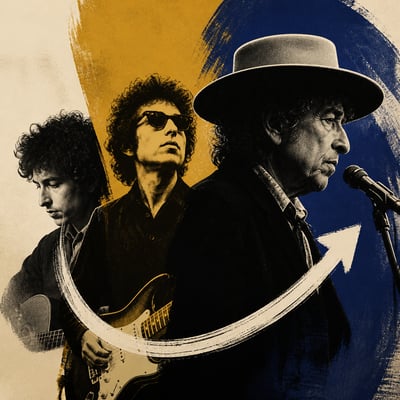
This topic centers on Bob Dylan as a continually changing artist whose career moves from folk revival and protest songs to electric rock, later confessional and standards-based material, and an unusually active late-career touring run. The coverage also tracks how new releases, the "A Complete Unknown" biopic, and recurring recognition around his catalog keep reframing his public profile. The core pattern is not a single event but a sustained cycle of reinvention, performance, and reassessment.
First Article: 07/14/13
Latest Article: 05/21/26
Summary
- Dylan is consistently framed as an artist who resists fixed categories, moving between folk, protest, electric rock, blues, standards, and later reflective material.
- The Newport 1965 electric shift remains a central reference point for understanding his career changes.
- Late-career touring is a major throughline, especially the Never Ending Tour and his continued live activity into his 80s.
- Recent discussion also centers on late-era songs and albums such as "Murder Most Foul," "Triplicate," and "Rough and Rowdy Ways."
- The biopic "A Complete Unknown" has renewed attention to Dylan’s early 1960s breakthrough and transition to electric performance.
- The Nobel Prize in Literature remains part of the ongoing framing of Dylan as both musician and literary figure.
- Across the material, the emphasis is less on one release than on the recurring pattern of transformation and public reappraisal.
History
The story shifts slightly from a general reinvention narrative to a more explicitly active, ongoing-performance framing. It now foregrounds the Never Ending Tour and recent late-career work as central evidence that Dylan remains a current creative presence, not just a historically important one.
The framing has broadened from Dylan’s active touring and live reinvention to a more explicit career-spanning interpretation centered on reinvention itself, especially the move from folk icon to electric innovator. The current version also adds clearer emphasis on ageing as evidence of durability, not decline.
Featured
Timeline: 4695 Days
Hover over any logo to see coverage summary, click for full article.