
 Climate
 Privacy
 Bob Dylan
 Drones
 Data Centers
 AI Governance
 2026 Maine Senate Race
Last Update: 08/01/2026 at 2:00 PM EST
AI Notetakers Face Privacy Litigation
Coverage from UC Today, Yahoo, and others
Articles
6
Active Days
140
The Topic
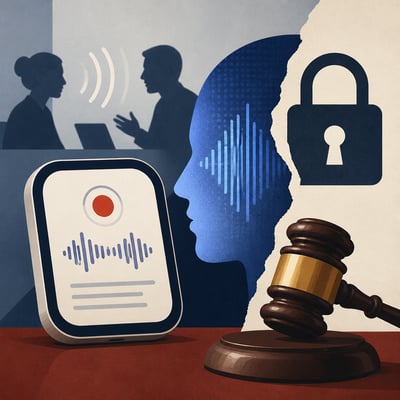
AI note-taking tools are drawing legal challenges over recording, transcription, biometric voice processing, and notice failures in workplaces and medical settings. The current signal is driven by class-action litigation and compliance guidance rather than broad regulatory action.
First Article: 02/20/26
Latest Article: 07/09/26
Summary
- AI meeting-notetakers and ambient scribes are the dominant privacy mechanism under scrutiny because they capture live speech, transcribe it, and may send recordings to third-party servers.
- Wiretap-style claims are recurring across the material, with federal and state interception laws used to test whether modern transcription tools fit older privacy statutes.
- Biometric voice identification is another major pressure point, especially under Illinois BIPA and related statutory-damages theories.
- Workplace use raises compliance issues around notice, consent, monitoring, employee controls, and how transcripts may affect hiring, review, or discipline decisions.
- Healthcare use adds a separate layer of sensitivity because recorded patient conversations and vendor processing implicate medical confidentiality and consent standards.
- The strongest current developments are private lawsuits and litigation milestones, not finalized regulation; the clearest examples involve Otter.ai and Abridge-related deployments.
- Organizations are responding with governance measures such as pre-meeting notice, opt-out controls, data-processing agreements, retention limits, and transfer safeguards.
History
This topic is new, but as new articles are added to it this area will summarize shifts, changes and expansions of the issues.
Featured
04-24-2026
Judge Eumi K. Lee will hear Otter.ai AI meeting-notes motion-to-dismiss arguments on 20 May 2026 in San Jose federal court after consolidation of ECPA and BIPA class actions.
05-11-2026
Otter.ai CEO Sam Liang describes enterprise meeting-data controls including Slack-like permissions and retention deletion while addressing recording-consent legal scrutiny.
07-09-2026
Privacy advocates and attorneys warn that AI notetakers used in virtual meetings can create voiceprints and retain transcripts without clear consent or deletion controls.
Timeline: 140 Days
Hover over any logo to see coverage summary, click for full article.
Additional Articles
⭐⭐⭐⭐⭐
A privacy analysis shows AI notetakers may trigger wiretap theories, prompting notices, controls, and data governance measures.
A class action targeting Otter.ai meeting transcription highlights Wiretap Act and Illinois BIPA risks for workplace AI notetakers, with additional notice, audit, and cross-border obligations.
On April 7, 2026, plaintiffs filed a Northern District of California putative class action alleging Sutter Health and others used Abridge AI scribe microphones to record and transmit confidential medical conversations without authorization.