
 Climate
 Privacy
 Bob Dylan
 Drones
 Data Centers
 AI Governance
 2026 Maine Senate Race
Coupang Breach Tests U.S.-Korea Ties
Coverage from Reuters, The New York Times, and others
00/00/0000
Articles
112
Active Days
165
The Topic
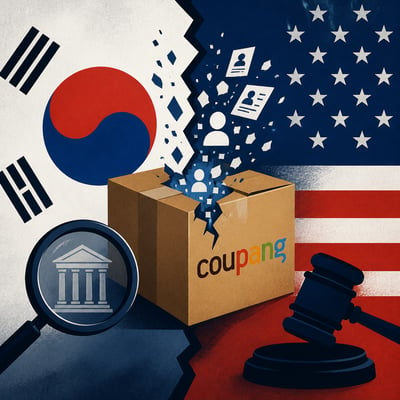
Coupang’s customer data breach has expanded from a corporate cybersecurity incident into a dispute over South Korean regulatory enforcement and U.S. treatment of an American-incorporated company. South Korean authorities say a former employee accessed data linked to more than 33 million accounts and imposed a record fine, while Coupang and U.S. lawmakers have challenged the investigation as discriminatory. The disagreement is affecting political and security discussions between Seoul and Washington, while questions remain about the location and use of the exposed data.
First Article: 02/12/26
Latest Article: 07/26/26
History
The core dispute has been reframed more explicitly as a challenge to South Korean regulatory enforcement against an American-incorporated company, rather than just a breach investigation. The current version adds a sharper claim from Seoul that Coupang is misstating how much data was retained, while preserving the broader U.S.-South Korea diplomatic friction.
The story sharpened into a more explicit dispute over the scope and fairness of South Korea’s enforcement, with new details on the size of the exposure and a record fine. It also broadened further into bilateral political and trade friction, while adding uncertainty about the data's ultimate destination.
- Record fine of about 624.6 billion won was imposed on Coupang.
- Authorities estimate exposure reached about 37.55 million people.
- Officials say they still do not know where the accessed data ended up.
- The dispute is now linked to broader bilateral defense and trade consultations.
- Coupang’s leadership and other business matters face intensified scrutiny.
The story has broadened from a privacy-breach enforcement case into a wider governance and cross-border dispute, with new FTC action and court intervention adding to the regulatory pressure on Coupang. U.S. investors and lawmakers are now more prominently part of the conflict, framing the case as alleged discriminatory treatment of a U.S.-listed firm.
- South Korea Fair Trade Commission added corporate control and disclosure scrutiny.
- Seoul High Court suspended the FTC designation pending litigation.
- U.S. investors and lawmakers challenged South Korea's enforcement approach.
- Regulators found covert browsing and activity collection without consent.
- Deleted logs after preservation orders became a regulatory issue.
The main change is a sharper shift from breach enforcement to broader governance intervention: South Korean regulators are now tying Coupang’s privacy case to control-structure oversight and formal compliance measures, not just fines and referrals. The dispute has also become more explicitly cross-border, with U.S. investors and lawmakers framing South Korean enforcement as discriminatory or politically pressured.
- Corporate governance measures tied to Coupang's control structure were added.
- Coupang said it will appeal the enforcement outcome.
- The case is now framed around access-key security and delayed notification failures.
- U.S. investors and lawmakers are challenging South Korean actions as discriminatory or pressured.
The biggest change is that the case has broadened from breach enforcement into a wider scrutiny of Coupang’s browsing and advertising data practices, while the cross-border dispute has sharpened around U.S. investor and lawmaker objections. South Korean regulators are now being framed as pursuing not just a data-breach response but a broader domestic enforcement campaign.
- Unauthorized collection of browsing and advertising-related data is now part of the case.
- Criminal and administrative enforcement channels are now explicitly involved.
- U.S. investors and lawmakers are objecting to discriminatory treatment of a U.S.-listed company.
- South Korean officials are defending the actions as domestic-law enforcement.
- Coupang faces ongoing legal challenges alongside leadership changes.
The story has broadened from a privacy-enforcement case into a wider governance and cross-border dispute, with new penalties, criminal exposure, and investor-led pressure intensifying the fallout. South Korean regulators and officials are now also clearly framing the matter as domestic-law enforcement despite external challenges.
- Criminal referrals were added to South Korea's response.
- Kim Bom became part of the regulatory dispute through controlling-entity designation.
- Coupang Fulfillment Services was separately penalized.
- Greenoaks Capital Partners and Altimeter Capital entered the dispute.
- Investor arbitration and complaints became more prominent.
The story has shifted from broad breach fallout to a more specific enforcement narrative: South Korean regulators have now imposed record penalties and tied the case to unlawful tracking and consent violations, not just the original data exposure. The dispute also looks more institutionalized, with cross-border objections from U.S. investors and lawmakers and South Korean officials defending domestic jurisdiction.
- South Korea imposed a record fine on Coupang.
- Regulators found unauthorized collection of online activity data from about 11 million customers.
- The breach remained undetected for an extended period.
- South Korean officials defended domestic jurisdiction against foreign objections.
- Regulators linked the incident to controlling-entity scrutiny and disclosure obligations.
The story has broadened from a breach-centered enforcement dispute into a wider governance and antitrust case, with more explicit cross-border litigation and accountability pressure. The current version also adds technical allegations about insider access and security-key misuse, strengthening the view that internal controls failed.
- Regulatory scrutiny now includes antitrust and related-party oversight.
- U.S. class-action litigation is now part of the case.
- New technical claims cite insider access and security-key misuse.
- The Korea CEO has departed amid accountability pressure.
- Administrative litigation is being planned.
Coupang's South Korea data breach remains the dominant issue, with enforcement, investor claims, and U.S.-South Korea disputes expanding around it. The breach has also produced measurable business fallout, including leadership changes, regulatory designation, and first-quarter losses.