

Last Update: 06/03/2026 at 7:25 AM EST
Facial recognition privacy enforcement in Australia
Coverage from JD Supra, The Guardian, and others
Articles
8
Latest Article
05/29
Active Days
122
Executive Summary
The cluster is primarily about Australian privacy regulation of retail facial recognition, centered on the Bunnings tribunal decisions and their implications for biometric collection, notice, and risk assessment. Current coverage shows a partial legal narrowing of one collection finding, while leaving transparency and notification failures intact. The broader pattern is a live governance dispute over whether retail biometric surveillance can be justified for crime prevention and under what procedural safeguards.
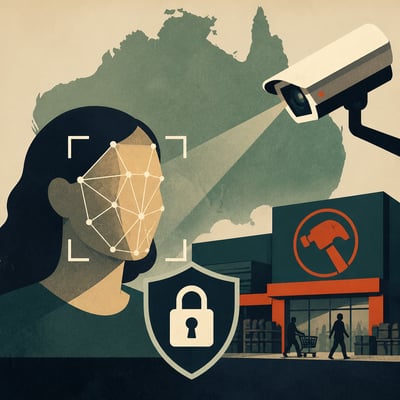
Key Points
- Bunnings' facial recognition use is the central reference point.
- The Administrative Review Tribunal softened one privacy finding but upheld transparency and notice violations.
- Biometric collection can be found even where the data is retained only briefly.
- Risk assessment and collection statements are now a key compliance expectation.
- Retail industry groups are arguing for clearer governance and privacy-law modernization.
- There is parallel evidence of public support for retail facial recognition when framed as crime prevention.
Featured Article
An Australian tribunal allowed Bunnings to use facial recognition for customer monitoring last week in Australia, raising concerns about biometric surveillance and privacy law gaps.
Coverage Timeline: 122 Days
Hover over any logo to see coverage summary, click for full article.
Additional Articles
⭐⭐⭐⭐⭐
Australians surveyed in February 2026 favor facial recognition in retail for safety and offender identification in Australia.
Administrative Review Tribunal in Australia on 4 February 2026 set aside Privacy Commissioner findings on facial recognition used in stores across Australia and New Zealand between 2018 and 2021, clarifying collection thresholds and transparency requirements.
Amnesty International and other civil society groups criticized India’s mostly non-binding AI governance as Delhi deployed facial recognition-based surveillance for policing and crowd monitoring.
Australia's Administrative Review Tribunal in 2026 overturned part of a Privacy Commissioner finding against Bunnings over facial recognition while upholding failures on transparency and notice.
⭐⭐⭐
Consumer neurotechnology companies are shipping brain and muscle signal devices at commercial scale in 2026 as FTC and state privacy rules face biometric data risks.
⭐️⭐️
Australian privacy regulator and Administrative Review Tribunal assess Bunnings facial recognition trial in Australian retail stores this week.
Experts cite privacy incidents around Ring, OpenAI, and Nest showing that state-level AI privacy regulation may need stronger accountability as AI becomes embedded in daily consumer life.