History
07/23/20260 new articles
The story broadens from general privacy and cybersecurity tightening into more specific enforcement around foreign-linked data access, vendor breach risk, and international rulemaking on biometric and labor-related data harms. The UK and global policy angle is also more explicit, with new emphasis on government access to encrypted cloud data and binding standards for algorithmic risks.
07/21/20261 new articles
The story broadens from general privacy tightening to a more specific mix of national-security scrutiny, facial-recognition litigation, and cloud-access disputes. It also adds clearer involvement from courts, civil-society groups, and healthcare vendors in shaping the next round of rules.
- State attorneys general are investigating foreign access to sensitive U.S. data as a national-security concern.
- UK courts are reviewing a cloud-access order affecting Apple.
- Facial recognition oversight now spans law enforcement, schools, and commercial venues.
- Healthcare business associates account for a substantial share of major breaches.
- An international labor standard is being developed for platform-economy algorithmic harms.
07/21/20266 new articles
The story has broadened from a general tightening of privacy rules into a more concrete compliance burden centered on specific operational areas like AI governance, ad-tech tracking, connected vehicles, and cross-border transfers. It also now places more weight on fragmented U.S. enforcement and overlapping privacy-plus-cybersecurity obligations.
- Connected-vehicle data is now a specific enforcement target.
- Data-breach duties are increasingly overlapping with privacy compliance.
- Canada and India are newly highlighted as active privacy jurisdictions.
- U.S. privacy enforcement is now framed as fragmented across multiple overlapping regimes.
- AI governance is now tied to impact assessments and notices.
06/21/20265 new articles
The story has broadened and sharpened around a more specific enforcement pattern: privacy authorities and courts are now focusing most on AI governance, biometrics, ad tech tracking, and cross-border data transfers. The current version also gives more weight to the 2025-2026 enforcement wave and less to the older background material.
06/16/20264 new articles
The story now places greater emphasis on U.S. state-level privacy rulemaking and enforcement, especially around location data sales, AI decisioning, and breach obligations. It also broadens the center of gravity slightly toward data brokers and platform/health-data compliance pressure, while Europe and Asia remain important but secondary.
06/11/20264 new articles
The story now reads as more operationalized and enforcement-heavy, with the addition of China and stronger emphasis on active rulemaking, automated-decision controls, and healthcare cyber/privacy exposure. The new framing suggests privacy risk is broadening from policy tightening into ongoing compliance execution and sector-specific enforcement.
05/30/20265 new articles
The story shifts from a broad enforcement-and-compliance theme to a more specific emphasis on AI governance, state privacy fragmentation, and implementation of cross-border and biometric controls. The new version also adds several concrete actors and examples, suggesting the pressure is now being driven more by current regulatory execution than by general legal tightening.
05/11/2026Topic Formed
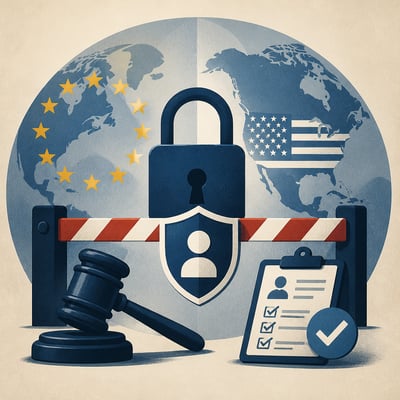
Privacy rules are tightening across the US, UK, EU, Canada, and India, with the strongest current pressure coming from AI governance, facial recognition, tracking oversight, breach exposure, and cross-border transfer controls. Enforcement and compliance work now span both consumer privacy laws and cybersecurity obligations, while older statutes continue to be used against modern data practices.

 Climate
 Privacy
 Bob Dylan
 Drones
 Data Centers
 AI Governance
 2026 Maine Senate Race