History
07/23/20260 new articles
The story is largely stable, but the current version sharpens the core framing: it now explicitly emphasizes ALPR systems as searchable location-surveillance tools and broadens the policy debate to oversight of private operators as well as police.
07/23/20260 new articles
The story now extends beyond state-level ALPR privacy limits to include a new federal proposal that would sharply narrow highway-fund recipients’ ALPR use. It also sharpens the legislative picture by naming specific new restrictions in Colorado, New Jersey, and Wyoming, alongside New Mexico’s out-of-state sharing limits.
- Proposed federal Title 23 funding condition limiting ALPRs to tolling.
- Colorado bill includes access logs and reporting requirements.
- New Jersey proposal targets out-of-state reproductive-health investigations.
- Wyoming proposal covers biometric and geolocation data access.
- Lawmakers in the U.S. House are now part of the story.
07/21/20263 new articles
New Mexico has moved from a leading legislative example to an enacted benchmark, while the story has broadened to include more states and a stronger push for transparency and outside-sharing limits. The frame also shifts from general ALPR privacy concerns to explicit restrictions on location histories being used for cross-border surveillance and sensitive-category enforcement.
- New Mexico has enacted SB 40, not just advanced it.
- Wyoming now appears among states weighing ALPR restrictions.
- Transparency rules are now a major part of the proposals.
- Flock is highlighted as a recurring ALPR vendor.
- The story now centers on location histories and protected-group tracking.
05/15/2026Topic Formed
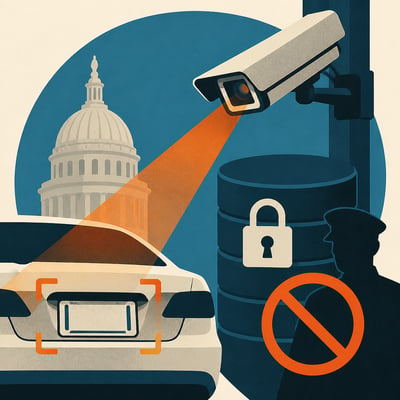
State legislatures are tightening rules around automated license plate readers, especially on data sharing, retention, and access by outside agencies. New Mexico has advanced or passed SB 40, while Michigan, Colorado, and New Jersey are considering similar limits tied to immigration enforcement, reproductive health, and warrant requirements.

 Climate
 Privacy
 Bob Dylan
 Drones
 Data Centers
 AI Governance
 2026 Maine Senate Race