Electronic Frontier Foundation / Thorin Klosowski03-10-2026
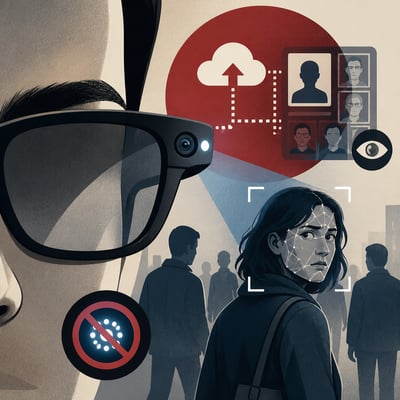
Meta Ray-Ban Display Glasses create privacy risks by default media uploads and potential human review for AI training, affecting bystanders in public spaces.
 CryptoBriefing07-15-2026
WIRED reported June 2026 that Meta built an unreleased NameTag on-device facial recognition feature for smart glasses, generating biometric signatures before removing code after executive disagreement.
 Yahoo / Anthony Cuthbertson07-10-2026
Meta filed a July 2 patent with the USPTO for an AI device that infers user mood from voice and nonverbal cues tied to location and activity.
 MacDailyNews07-20-2026
An investigation reported Ray-Ban Meta smart glasses sent intimate videos to Kenya-based contractors for AI training, with frequent face-blur failures and privacy risks.
 Gadget Review / Annemarije de Boer07-27-2026
Activists staged a lenticular parody near Meta UK offices in London to highlight consent and facial-recognition risks from Ray-Ban Meta smart glasses, citing 2024 Harvard findings.
 Newser / John Johnson07-18-2026
Meta issued a mandatory update for Ray-Ban smart glasses in response to privacy backlash over recording light behavior and public filming concerns.
The Conversation / Brynn Colledge04-14-2025 Meta smart glasses may add facial recognition, raising privacy and safety concerns including covert filming risks and worsened exposure harms for sex workers.
Yahoo / Anthony Cuthbertson06-05-2026 Meta added dormant NameTag facial recognition code to the Meta AI app for Ray-Ban and Oakley smart glasses, while researchers warned about biometric identification risks.
 Fortune / Tatiana Sataua07-28-2026
Instagram removed harassment content recorded with Meta Ray-Ban smart glasses as privacy concerns grew around recording indicators, contractor access, and facial recognition plans.
 The Verge / Jay Peters07-08-2026
Meta develops super sensing smart glasses with continuous audio and photo capture, proposing metadata-only processing while changing LED indicator controls to address recording notice concerns.
 CNET / Omar Gallaga06-05-2026
Meta embedded NameTag facial recognition code into the Meta AI app for smart glasses, with EFF Threat Lab confirming a potential on-phone faceprint matching workflow.
CNET / Omar Gallaga06-16-2026 Wired and Electronic Frontier Foundation reported dormant facial-recognition code in Meta smart glasses and a potential Rank One Computing biometric technology link in June.
 Futurism07-18-2026
Meta executives Andrew Bosworth and Andy Stone addressed Wired reporting on NameTag, an unreleased AI Glasses facial recognition feature, including local encrypted biometric faceprints.
Futurism / Victor Tangermann07-26-2026 Meta announced removal and bans for Instagram harassment videos recorded with camera-equipped AI glasses after privacy and consent concerns surfaced in 2020s reporting.
 TechCrunch / Sarah Perez03-05-2026
Meta faces a privacy lawsuit in the United States and an ICO probe in the United Kingdom in 2025 over smart glasses data collection and overseas footage review.
 Engadget / Matt Tate02-13-2026
Meta plans facial recognition for smart glasses in the United States, according to unnamed sources.
 New York Post06-05-2026
Wired reported in 2024 that Meta embedded unactivated NameTag facial recognition code in an AI companion app for smart glasses, drawing privacy watchdog scrutiny.
 975kgkl / Tasha Stevens05-20-2026
Texas Attorney General Ken Paxton opened a consumer protection investigation into Meta AI Glasses, alleging continuous data capture, facial geometry risks, and privacy marketing issues in the 2020s.
 The Eastern Herald06-28-2026
EFF researchers and subsequent legal and investigative reporting link Meta Ray-Ban glasses to dormant facial recognition and disputed biometric training-data practices across multiple countries in 2025-2026.
 TechTimes / Chase Fiorini07-24-2026
Meta launched Facebook Verified in the 2020s, using facial recognition to match video selfies to profile photos after prior Illinois and Texas biometric settlements.
 The Tech Buzz07-15-2026
Meta executives issued conflicting statements about the NameTag facial recognition system, prompting privacy concerns as EU AI Act and U.S. lawmakers scrutinize Meta AI practices.
Gadgetreview / Rex Freiberger06-09-2026 WIRED reported Meta embedded NameTag facial-recognition code in the Meta AI app for Ray-Ban Meta smart glasses, and Meta removed most traces within 24 hours.
 MacRumors / Tim Hardwick07-09-2026
Meta prototypes super-sensing smart glasses with continuous audio and frequent image capture, prompting privacy experts to warn about biometric law risk and U.S. wiretapping consent uncertainty.
 Wired / Dell Cameron06-15-2026
Meta tested Rank One Computing face recognition in smart glasses in 2026, then removed the feature on June 5 after reporting of dormant biometric integration.
 Social Media Today / Andrew Hutchinson07-09-2026
Meta CTO Andrew Bosworth said Meta is considering facial identification for Meta AI glasses, focusing on encrypted recognition of known people rather than unknown individuals.
 Digital Trends / Sudhanshu Kumar Mangalam06-09-2026
WIRED reported dormant NameTag face-identification references in the Meta AI app for Ray-Ban Meta smart glasses, later removed in an update, raising consent concerns.
 Android Headlines / Jean Leon06-15-2026
WIRED reported a secret licensing deal in which Meta licensed Rank One Computing facial recognition and liveness tools for smart glasses prototypes, then removed dormant code on June 5.
 The Cool Down / Curtis Deacon06-15-2026
Wired reported hidden NameTag facial-recognition code in Meta smart glasses, prompting Meta officials to deny consumer availability and critics to raise surveillance concerns.
 Natural News06-14-2026
Meta removed most NameTag facial recognition code from the Meta AI app after reporting, as a class action alleges Meta Pixel collected sensitive healthcare data without consent.
 Newstarget06-14-2026
Meta removed unreleased NameTag facial-recognition code from Meta AI after reporting, while a class action alleges Meta Pixel collects sensitive healthcare data from U.S. hospitals and patient portals for advertising.
Cryptobriefing07-08-2026 Ken Paxton opened a May 21, 2026 Texas investigation into Meta smart glasses over potential unlawful biometric capture and unauthorized bystander recording.
The Verge07-27-2026 Meta announced a mandatory update for Ray-Ban smart glasses in response to public concerns about bystander privacy and reported tampering of the camera privacy light.
CNET / Scott Stein07-08-2026 Meta released tamper-aware firmware for smart glasses to disable recording on LED tampering as privacy concerns persisted across public recording, AI photo handling, and emerging facial recognition features.
 Fstoppers / Alex Cooke07-18-2026
In London, a UK activist group protested Meta camera glasses over reported super sensing features and demonstrated identification via facial-search and people-search tools.
BiometricUpdate.com / Anthony Kimery03-18-2026 U.S. Democratic senators sought answers from Meta over proposed facial recognition in Meta AI smart glasses, citing covert ambient identification risks and potential biometric-data misuse in public and immigration contexts.
 Salon / Andi Zeisler07-02-2026
Meta launched Starfire Kylie smart glasses with facial-recognition and recording capabilities amid criticism about consent and surveillance-oriented data practices.
 The Independent / Nicole Wootton-Cane02-20-2026
Charities warn Meta's facial recognition plans for smart glasses in 2025 risk survivor safety in the UK and beyond.
The Independent / Nicole Wootton-Cane02-20-2026 Meta plans facial recognition for smart glasses, raising privacy and safety concerns for survivors in the United Kingdom, according to reports citing a New York Times story.
 Inc / Kevin Haynes02-14-2026
Meta plans facial recognition in Ray-Ban Oakley smart glasses in the 2020s in the United States.
CNET03-16-2026 Meta's smart glasses data may be reviewed by third party contractors when AI features are used in Kenya.
CNET03-16-2026 Meta's Ray-Ban smart glasses may expose data to third party contractors during cloud AI processing, raising privacy concerns in Kenya and beyond.
 Republic World03-06-2026
Meta faces a Swedish lawsuit over processing of user footage reviewed by Kenyan data annotators in 2025.
 Firstpost / Anuj Trehan03-05-2026
Investigations revealed that Meta's Ray-Ban smart glasses recordings are reviewed by overseas contractors in Nairobi to train AI models.
 Gizmodo / Kyle Barr02-13-2026
Meta plans to add facial recognition to smart glasses, potentially enabling continuous biometric data collection in the United States during a politically turbulent period.
 Tom's Guide / Amanda Caswell03-05-2026
Swedish newspapers report that Meta Ray-Ban glasses are reviewed by humans after user interactions in Nairobi, Kenya, prompting a class action over privacy.
 MyNorthwest.com / Charlie Harger03-04-2026
Investigators in 2025 reveal private footage captured by Meta Ray Ban glasses in Nairobi, prompting privacy and data handling concerns.
36kr02-14-2025 In February 2025, Lei Technology describes how Meta's potential Name Tag facial recognition feature for U.S. smart glasses raises significant biometric privacy and surveillance concerns.
Information Age01-01-1900 Meta plans to add Name Tag facial recognition to smart glasses as soon as 2026 in global markets including Australia, prompting regulator scrutiny and expert warnings.
 Oligarch Watch / Caleb Ecarma02-17-2026
Reports show men using Meta Ray-Ban smart glasses to secretly record women and children in public, while Meta explores facial recognition tied to Instagram accounts across the USA and Europe.
 AOL03-08-2026
Meta's smart glasses privacy comes under scrutiny after a 2025 investigation in Nairobi, Kenya.
 Geeky Gadgets / Julian Horsey03-04-2026
Meta investigates Name Tag facial recognition in smart glasses, ongoing discussions weigh accessibility benefits against privacy and safety concerns.
 gHacks / Arthur Kay02-15-2026
Meta plans to add real time facial recognition to smart glasses for use in public spaces this year.
 igor´sLAB / Karsten Rabeneck-Ketme02-16-2026
Meta has explored integrating facial recognition into Ray-Ban smart glasses in 2020s discussions, prompting privacy and GDPR-related scrutiny in Europe and the United States.
 UC Today / Christopher Carey02-16-2026
Meta is testing a facial-recognition feature for smart glasses with EssilorLuxottica in 2020s, raising biometric privacy and regulatory concerns in the USA and Europe.
 Glass Almanac / Emily Thompson02-25-2026
Meta plans on-device facial recognition for Ray Ban glasses in 2026, amid regulatory scrutiny in the United States and European Union.
Glass Almanac / Emily Thompson03-05-2026 Regulators evaluate GDPR compliance as EU user data is reviewed in Nairobi and other non EU locations for Meta Glasses AI training in March 2026.
 Lifehacker / Stephen Johnson02-18-2026
Meta plans facial recognition in Ray-Ban and Oakley glasses this year amid privacy concerns.
Inc. / Ava Levinson03-04-2026 Meta collects video with Ray-Ban smart glasses and transmits it to external annotators for AI training in global deployments, currently raising privacy concerns about bystander consent.
 Straight Arrow News / Mikael Thalen02-14-2026
Meta plans timed launch of facial-recognition on smart glasses, prompting U.S. privacy concerns from civil liberties groups and demonstrations of misuse.
 uniladtech / Tom Chapman03-09-2026
Meta faces privacy suit over wearable glasses in Kenya as 2025 sales heighten regulatory scrutiny.
 Kkam / Tasha Stevens05-20-2026
Texas Attorney General Ken Paxton opened a consumer protection investigation into Meta AI Glasses in 2020s-era scrutiny over always enabled recording and facial biometric data handling.
 Daily Sabah / Yunus Emre Tozal05-27-2026
Meta smart glasses and U.S. immigration enforcement plans expand real-time facial recognition in U.S. public spaces, while Illinois BIPA and EU AI Act phase in biometric limits.
 Business Insider / Katie Notopoulos07-22-2026
Meta smart glasses drew public backlash in the United Kingdom after a Kylie Jenner launch, with renewed scrutiny of AI features and potential facial recognition risks in public.
 Theroot / Mahalia Otshudy07-01-2026
Teyana Taylor wearing Ray-Ban Meta smart glasses at the BET Awards triggered criticism about covert recording and facial-recognition re-identification risks in the United States.
 Fox News03-08-2026
Meta data review by contractors in Nairobi in 2025 highlights privacy risks from smart glasses.
 Fox News03-08-2026
In Kenya in 2025, Meta's smart glasses raise privacy concerns as contractors review captured data for AI training.
 WebProNews / Ava Callegari05-23-2026
Brady Snyder adjusts Meta smart-glasses settings while Swedish reporting alleges Nairobi contractors reviewed sensitive footage and the UK ICO calls for stronger user control.
 https:02-16-2026
Meta plans limited facial recognition on AI smart glasses later this year in the United States amid privacy scrutiny.
 Aicerts News04-07-2026
Meta faced privacy backlash in the UK, Ireland, Kenya, and the USA over wearable AI glasses featuring recording workflows, possible real-time facial recognition, and contested disclosures.
Human+AI / Nicolle Weeks07-07-2026 Nicolle Weeks argues Meta Kylie Jenner smart glasses normalize ambient surveillance by hiding sensors and weakening bystander notice under Canada’s PIPEDA and Quebec Law 25 gap.
 EFF / Cooper Quintin06-04-2026
Wired and EFF Threat Lab report Meta facial recognition code running on millions of always-on surveillance glasses, matching faces against stored biometric faceprints.
EFF / Cooper Quintin06-08-2026 EFF Threat Lab and researchers found facial recognition code in Meta AI smart-glasses software, and Meta removed it in a June 5 update after public scrutiny.
 PhoneArena / Mariyan Slavov06-16-2026
Meta reportedly developed a facial recognition feature for Ray-Ban Meta smart glasses using biometric data on users' phones, while Meta stated no final consumer rollout decision exists.
 Northeastern Global News / Hannah Morse06-22-2026
Privacy experts said Meta smart glasses facial recognition renews regulatory gaps after reporting described faceprints stored on the user phone and limited opt-in consent.

 Climate
 Privacy
 Bob Dylan
 Drones
 Data Centers
 AI Governance
 2026 Maine Senate Race