
 AI Governance
 Data Centers
 Drones
 Climate
 Privacy
 2026 Maine Senate
 Bob Dylan
AI Industry Battles Over U.S. Rules
Coverage from WFAE, STLPR, and others
U.
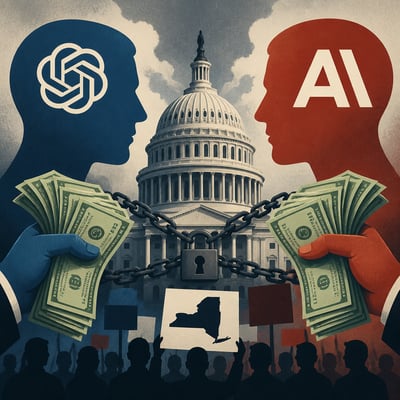
S. AI governance is increasingly contested through elections, super PACs, lobbying, and state-level legislation. The strongest current pattern is an industry-backed fight over federal preemption versus state safeguards, with safety reporting, transparency, child protection, export controls, and frontier-model review as recurring policy levers. Federal legislative gridlock keeps the issue ongoing and shifts activity toward statehouses and campaigns, while spending totals and their effect on legislation remain difficult to compare.
The story now includes concrete state-level regulatory outcomes, not just lobbying and election influence: Colorado narrowed an enjoined framework while California's advanced-AI bill was vetoed. The policy contest has also broadened toward deployment controls, export restrictions, and child safety.
The story now has a more concrete measure of the political campaign: AI-linked groups directed more than $15 million into Alex Bores’s New York congressional primary. The RAISE Act’s proposed requirements are also stated more specifically, including safety-protocol disclosures and significant-incident reporting.
The story is framed more explicitly as a broad political and regulatory contest over AI governance, with new emphasis on lobbying by major firms and on California transparency and enforcement debates. The New York primary remains central, but the current version shifts focus from election spending as a visibility event to a wider influence campaign shaping future federal and state rules.
The story now centers more explicitly on the policy battle over federal preemption versus state experimentation, and it adds a concrete electoral outcome: AI-linked spending in New York's NY-12 primary failed to carry Alex Bores to victory. The framing also broadens from campaign spending into a wider governance fight covering model release controls, incident reporting, child safety, and political influence.
- NY-12 primary drew over $15 million in AI-linked messaging.
- Alex Bores lost the primary to Micah Lasher.
- State AI laws in California and Colorado face legal or political rollback.
- Governance debate now includes frontier-model release controls and incident reporting.
- Material evidence remains limited that spending directly drives legislative outcomes.
The story now suggests industry spending has not made AI safeguards politically toxic: a pro-safeguards candidate won despite opposition from AI-aligned groups. The contest is increasingly framed as a national-versus-state regulatory conflict, with the 2026 elections emerging as a key arena while Congress remains stalled.
The story broadens from a New York-centered proxy fight into a wider, better-funded 2026 election effort spanning multiple states and linked to data center and transparency debates. It also adds a more nuanced outcome: heavy spending may boost regulation-minded candidates, but does not reliably decide races.
- Leading the Future has raised more than $100 million, possibly over $125 million.
- Colorado and Utah races are now part of the AI spending fight.
- Campaigns now also target data center water and infrastructure issues.
- Spending may have helped regulation-focused candidates despite electoral losses.
- Lawmakers broadly agree some AI policy response is needed.
The story now centers more explicitly on election spending as the mechanism shaping AI regulation, with New York’s Alex Bores race emerging as the main test case. It also adds a new federal dimension: the Trump administration is now actively reviewing advanced models and affecting how OpenAI can release them.
- New York primary politics became a test case for AI regulation spending.
- The Trump administration intervened in OpenAI's GPT-5.6 release plans.
- Defense contracting is affecting AI safety rules through procurement incentives.
- The spending surge is signaling to other candidates and lawmakers.
The story shifts from a broad fight over AI governance into a more concrete account of the tools now being used to influence outcomes: super PACs, nonprofit advocacy, lawsuits, and procurement levers. It also sharpens the cast around OpenAI and Anthropic, showing them as the central antagonists in a state-led and federal review struggle.
The story has broadened from a mainly election-and-lobbying fight over AI regulation into a wider governance contest that now explicitly includes state legislation, procurement rules, and defense contracting. That reframes the issue from influencing a few races to shaping the enforcement mechanics and safety standards that will govern deployment.
- State-level legislation is now a central venue for AI rulemaking.
- Federal procurement and defense use are shaping AI safety incentives.
- Meta, Google, and Nvidia are now named as active political actors.
- Transparency, incident reporting, and safeguards have become explicit policy demands.
- Stricter liability and penalties are now a clearer point of industry opposition.
AI companies, investors, and aligned super PACs are spending heavily to influence the next generation of U.S. AI regulation. The clearest battleground is New York's NY-12 primary, where Alex Bores has become the target of a large proxy fight over whether AI rules should be set mainly at the federal level or also through stronger state laws. The spending reflects both policy disagreement and competition between major AI firms, especially OpenAI and Anthropic, while Congress remains stalled on legislation.