
 AI Governance
 Data Centers
 Drones
 Climate
 Privacy
 2026 Maine Senate
 Bob Dylan
U.S. AI Preemption Versus State Rulemaking
Coverage from AP News, ABC News, and others
U.
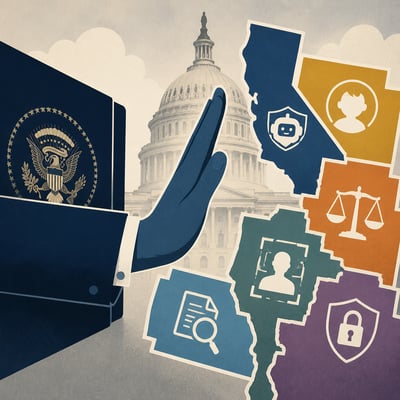
S. states continue expanding targeted AI rules while the White House and congressional allies pursue federal preemption and a more uniform national framework. State measures increasingly address child-facing chatbots, consequential automated decisions, frontier-model safety, synthetic-media provenance, healthcare, employment, and data-center impacts. Congress has not produced a comprehensive federal statute, leaving executive actions, voluntary standards, procurement rules, agency proposals, and state attorneys general enforcement to shape near-term obligations.
The story has broadened from a state-versus-federal preemption dispute into a wider governance landscape, with state enforcement and data-center regulation emerging alongside federal executive and administrative tools. The scale of state activity is now quantified, while comprehensive federal legislation remains absent.
The story is now framed less as a broad state-versus-federal AI governance clash and more as a concrete push toward targeted rules on chatbots, consequential decisions, and content provenance. It also adds a more specific federal compromise pathway: temporary override of some state rules in exchange for child-protection and anti-deepfake measures, though that deal is not law.
The story has broadened from targeted state AI rules and federal resistance into a more expansive, multi-issue governance fight that now includes infrastructure impacts, synthetic media, and stronger obligations on deployers. The federal preemption debate remains unresolved, but states are clearly moving toward a wider compliance regime.
- State AI governance now covers data-center, water-use, and utility impacts.
- Multistate deployers face inventories, vendor controls, and impact-assessment duties.
- Some states now require incident reporting and whistleblower protections for frontier models.
- Federal preemption proposals are linked to child-safety and deepfake bills.
- Digital-replica protections are now part of the AI policy agenda.
The story has broadened from a general state-versus-federal AI-regulation clash into a more detailed account of the specific federal tools being used and the specific policy domains states are targeting. The biggest new development is the inclusion of training-data transparency, executive orders, voluntary testing frameworks, export controls, and procurement conditions as part of the federal-state regulatory contest.
The main shift is that the story is now framed more explicitly around Trump administration efforts to preempt state AI laws, alongside a narrower set of state actions that are moving into execution. The state patchwork remains the core outcome, but the current version emphasizes chatbot, employment disclosure, frontier-model, and provenance rules as the concrete regulatory front lines.
The story has become more concrete and broader, shifting from a general federal-versus-state AI fight to a denser mix of enacted state rules and specific federal-state bargaining over preemption, safety review, and youth protections. It now also clearly includes adjacent enforcement and governance channels like privacy, discrimination, and high-stakes automated decisions.
- New bills and enacted state measures span consumer, education, healthcare, employment, and government use.
- Privacy enforcement now overlaps with AI governance through CCPA/CPRA, FTC, HIPAA, and discrimination law.
- Deepfakes and synthetic media transparency are now a standard state legislative focus.
- The White House is pushing federal AI framework, preemption, and model review proposals.
- Some state laws now emphasize audits, sandboxing, or liability.
The central story is a growing struggle over who sets AI rules in the United States: the Trump administration is trying to block or narrow state regulation, while states continue passing targeted laws. The result is a fragmented but active regulatory landscape focused on chatbots, child safety, workplace decision-making, transparency, and developer safeguards. Congressional efforts to create a national framework remain unsettled, so executive action and state law are doing most of the governing for now.