History
07/22/20260 new articles
The story now places stronger emphasis on execution hurdles and governance quality, shifting from a broad integration theme to whether announced regional frameworks and market mechanisms can actually deliver measurable outcomes. It also broadens the environmental agenda to more explicitly include biodiversity, pollution, and water security alongside climate action.
07/22/20260 new articles
The story now emphasizes execution: Asian climate action is shifting from broad nature-and-policy coordination toward concrete implementation channels, especially Article 6 project pipelines, China’s expanding carbon market, and regional power connectivity. It also sharpens the constraint picture by stressing fragmented implementation and uneven national capacity, not just finance and verification gaps.
07/22/20260 new articles
The story now places much greater emphasis on implementation mechanics: high-integrity monitoring, verification, and digital tracking have become central to making nature-based carbon projects investable. It also sharpens the regional picture by highlighting China’s expanding emissions trading system and cross-border clean-energy connectivity as concrete market and infrastructure pillars.
07/22/20261 new articles
The story has broadened from climate implementation tools to a more integrated regional governance agenda that explicitly links climate action with biodiversity and pollution management. A new ESCAP roadmap and tighter emphasis on project quality, verified co-benefits, and investor-ready data make coordination and credibility more central.
- ESCAP adopted a 2026-2030 climate-nature roadmap.
- Regional policy is now explicitly integrated across climate, biodiversity, and pollution.
- Private investors and corporate carbon-credit buyers are newly foregrounded.
- China’s emissions trading system is expanding coverage.
- Verified co-benefits are now a condition for mobilizing private finance.
05/19/20260 new articles
The story shifts from a broad focus on climate governance tools to a more explicit emphasis on implementation capacity: financing gaps, carbon-market design, and cross-border infrastructure are now framed as the main bottlenecks. The current version also adds China’s carbon market expansion and UNFCCC-linked loss-and-damage financing as more concrete policy anchors.
05/11/2026Topic Formed
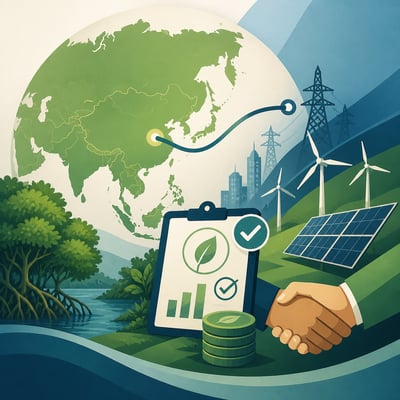
The cluster centers on Asia-facing climate governance and implementation: nature-based solutions, carbon-market MRV, Article 6 cooperation, and regional clean-energy coordination. The current signal emphasizes operational financing and verification systems rather than climate ambition alone, with governments, market intermediaries, and regional forums framing climate action as a governance-and-capital deployment problem.

 Climate
 Privacy
 Bob Dylan
 Drones
 Data Centers
 AI Governance
 2026 Maine Senate Race