History
07/22/20260 new articles
The story now places greater emphasis on recent US restrictions and a more specific research finding: climate factors are rarely the sole driver of migration, but they materially shape layered displacement decisions. It also broadens the framing from a general climate-migration mismatch to a more detailed protection gap affecting climate-affected migrants facing detention, deportation, or irregular movement.
06/29/20260 new articles
The story has been reframed more tightly around US asylum and immigration rules as the core bottleneck, with added emphasis that climate displacement is usually only one factor in mixed migration decisions. The current version also broadens the political context by highlighting lawmakers and advocates floating protection ideas amid a weak reform outlook.
06/14/20263 new articles
The story has broadened from a general climate-migration narrative to a sharper policy-gap frame centered on US immigration enforcement and limited legal protection for climate-displaced people. It now explicitly extends beyond Central America to Sudan and Somalia, making the mismatch between worsening climate shocks and available asylum or TPS pathways the dominant point.
- US immigration enforcement is now explicitly linked to climate-displacement pressures.
- Coverage now includes Sudan and Somalia alongside Central America.
- Asylum, refugee, and TPS pathways are described as limited or politically constrained.
- A climate-displaced persons visa is presented as politically weak.
- The framing shifts toward international governance and migration management.
05/22/20260 new articles
The story is slightly reframed from a broad climate-and-migration linkage to a more specific focus on asylum and protection systems, especially in Mexico and along migration routes. The underlying causal picture is unchanged, but the current version puts governance and displacement pressure more prominently at the center.
05/11/2026Topic Formed
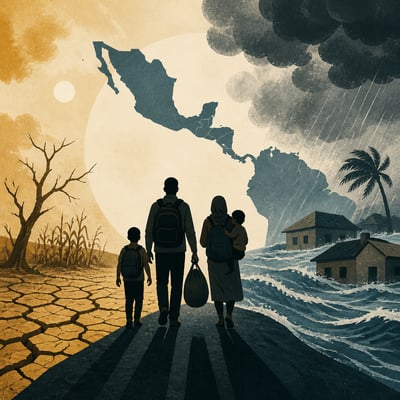
Recent material links climate stress to migration through drought, flooding, hurricanes, heat, crop losses, and weak public support, with Central America and Mexico as the most visible geography. The strongest current signal combines displacement pressures, protection policy questions, and the use of survey or projection data to frame climate as a migration driver alongside violence and economic hardship.

 Climate
 Privacy
 Bob Dylan
 Drones
 Data Centers
 AI Governance
 2026 Maine Senate Race