

Last Update: 06/03/2026 at 4:25 AM EST
Colorado River Water Crisis Deepens
Coverage from Inside Climate News, The Guardian, and others
Articles
13
Latest Article
06/02
Active Days
96
Executive Summary
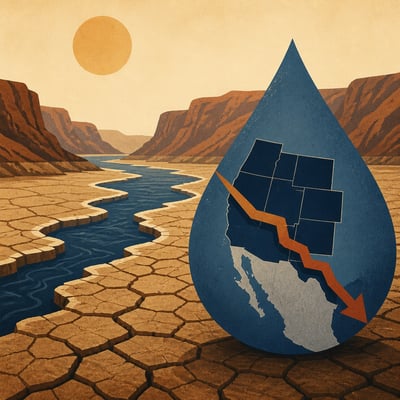
Colorado River water stress is intensifying as low snowpack, warming, and long-running drought reduce supplies faster than conservation can compensate. Basin states are still split over mandatory cutbacks, while cities and water managers push reuse, desalination, and other adaptation measures.
Key Points
- Low snowpack, warming, and sustained drought are driving sharply weaker Colorado River runoff and reservoir levels.
- Conservation and demand management help reduce use, but modeled gains often do not offset climate-driven supply losses.
- Basin-state negotiations remain unsettled, with California, Arizona, and Nevada proposing cuts while Upper Basin states resist a binding deal.
- The largest pressure point is agriculture, which still accounts for most river use and is likely to absorb major reductions.
- Adaptation options now recur across the material: wastewater reuse, desalination, efficiency upgrades, and cross-sector water limits.
- Water governance is becoming more contested, with proposals for adaptive management, federal intervention, and new legal frameworks.
- Local water-risk problems extend beyond quantity, including contamination, salinity, and radionuclide exposure in parts of Colorado.
Featured Article
Researchers analyze Phoenix, Las Vegas, and Denver demand management and find climate-driven Colorado River runoff decline can exceed conservation gains.
Coverage Timeline: 96 Days
Hover over any logo to see coverage summary, click for full article.
Additional Articles
⭐⭐⭐⭐⭐
Experts released a Colorado River Basin risk report in 2027 planning context, warning drought winters could nearly dry Lakes Mead and Powell without permanent water-use cuts.
Seven states and Mexico must agree on river sharing rules by September amid drought and potential federal intervention.
U.S. Bureau of Reclamation projections released in 2026 indicate record-low Lake Mead and Lake Powell levels, driven by snow drought and heat-amplified runoff deficits affecting water supplies and hydropower.
Researchers model Colorado River water availability for Phoenix, Las Vegas, and Denver and find conservation may be insufficient under plausible emissions-driven supply declines by 2060.
Colorado’s water managers face climate-driven Colorado River flow declines while prior-appropriation incentives promote conflict, prompting calls for collaborative adaptive governance.
Researchers project that climate intensification of Southwest drought could create future municipal water shortages in Phoenix, Las Vegas, and Denver despite conservation measures.
Researchers modeled drought-driven water shortages in Phoenix, Las Vegas, and Denver and found climate change can overwhelm conservation gains, requiring supply augmentation and cross-sector demand changes.
Anne Castle warns that low Rocky Mountain snowpack and a widening Colorado River deficit require enforceable basinwide water reductions and expanded drought mitigation funding as negotiations stall.
⭐⭐⭐
California, Arizona, and Nevada proposed voluntary water cutbacks for up to three years on the Colorado River amid historically low Lake Mead and Lake Powell levels.
Colorado River Indian Tribes granted Colorado River personhood status in tribal law in November to strengthen stewardship amid climate change and water overuse pressures.
Construction of the Arkansas Valley Conduit in southeastern Colorado continues after a presidential veto, as river contamination and declining flows threaten water security for roughly 50,000 residents.
Solar Energy Industries Association hired Tim Pawlenty while Colorado River states negotiated water reductions amid drought, with potential mandatory cuts considered by the Trump administration.