
 Climate
 Privacy
 Bob Dylan
 Drones
 Data Centers
 AI Governance
 2026 Maine Senate Race
AI Drives Carbon Capture Gas Power
Coverage from Axios, Investigate Midwest, and others
Articles
22
Active Days
272
The Topic
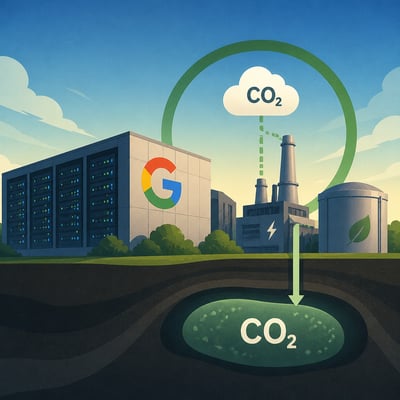
Rapidly growing electricity demand from AI data centers is reviving interest in pairing natural-gas power plants with carbon capture and storage in the United States. Google’s planned 400-megawatt Broadwing project in Illinois is the clearest announced example, while larger proposals in Nebraska and other regions remain under development or investigation. The approach could provide reliable power with lower direct emissions, but high capital costs, limited operating experience, uncertain financing, storage logistics, and policy changes continue to constrain deployment.
First Article: 10/23/25
Latest Article: 07/21/26
Summary
- AI-driven data-center expansion is increasing demand for reliable, around-the-clock electricity.
- Google has agreed to buy most power from the planned 400-megawatt Broadwing gas plant in Decatur, Illinois, which is designed to capture about 90% of its carbon dioxide.
- Tenaska is assembling land for a potential 1,000-to-3,000-megawatt gas plant linked to a large Google data center in Nebraska; whether carbon capture will be included remains unclear.
- At least several other U.S. concepts involving Google, Meta, ExxonMobil, and Chevron are under consideration, but no U.S. natural-gas plant currently operates with carbon capture equipment.
- Studies identify Texas, Virginia, Pennsylvania, Ohio, Arizona, Colorado, Utah, Illinois, and parts of the central and Gulf regions as potential areas for data-center demand and carbon storage.
- High capital costs, financing requirements, permitting, transport, and the lack of large-scale operating experience remain the main barriers to commercialization.
- Saline aquifers could provide substantial storage capacity, but estimates depend on assumptions about future data-center growth, electricity mixes, capture performance, and access to out-of-state storage.
History
The story broadens from Google’s and Tenaska’s specific projects into a wider U.S. commercialization picture, adding more candidate companies, regions, and infrastructure constraints. It also sharpens the barriers to deployment by emphasizing financing, permitting, transport, and the lack of large-scale operating experience.
The story has broadened from Google’s Illinois CCS-backed gas plant into a wider wave of proposed gas-plus-CCS projects for AI data centers, especially a much larger Nebraska concept that could test the model at utility scale. The new version also sharpens the uncertainty: despite rising interest, commercial deployment in U.S. gas generation remains unproven.
Featured
Timeline: 272 Days
Hover over any logo to see coverage summary, click for full article.