History
07/25/20260 new articles
The story now broadens from a general account of extreme heat impacts to a more specific framing that adds climate attribution, sharper attention to repeated July risks, and named new actors. It also strengthens the wildfire and mortality narrative by emphasizing France and Spain as the most severe cases and highlighting heat without air conditioning as a key vulnerability.
07/24/20260 new articles
The story broadened from a Europe-centered heatwave crisis to a transatlantic one, with a major new US heat dome adding scale and urgency. The updated version also sharpens the mortality picture by emphasizing deaths at home, vulnerable people without cooling, and sharper disagreement over attribution methods.
- A US heat dome placed more than 140 million people under heat alerts.
- Officials linked the US heatwave to at least two dozen suspected deaths.
- Deaths at home in France rose sharply during the heatwave.
- Wildfires caused evacuations and burned large areas in southern Europe.
- Heat disrupted public events and tourism more explicitly than before.
07/23/20262 new articles
The story broadens from a France-and-Spain heatwave mortality report into a wider European disruption story, adding transport, power, tourism, school, and work impacts. It also sharpens the mortality framing by emphasizing that official excess-death counts and climate-attribution estimates are not directly comparable.
- Heatwaves now described as affecting several European countries beyond France and Spain.
- Disruptions to schools, transport, power supplies, tourism, and outdoor work are newly highlighted.
- Mortality totals are said to be hard to compare because methods measure different things.
- Older and medically vulnerable people are singled out as the main affected group.
07/23/20262 new articles
The story sharpens around France and Spain’s worsening heat impacts, adding renewed July warnings, wildfire escalation across southern Europe, and a clearer emphasis on excess mortality estimates. It also shifts slightly from broad disruption to the public-health and adaptation challenge of protecting people with better cooling and alerts.
- Renewed extreme heat is expected in Spain and France in early July.
- Wildfires are now reported in Spain, France and Italy.
- France’s death toll is framed as 2,000 weekly excess deaths to over 2,700 broader-event deaths.
- The story now foregrounds cooling access and heat alerts as key adaptation measures.
07/22/20260 new articles
The story has broadened from a general pattern of repeated European heatwaves to a specific, record-setting June 2026 event with quantified mortality and cross-border disruption. It also now includes a separate US heatwave, making the overall picture more global and urgent.
- June 2026 heatwave set a 36.9C national daily-high average in France.
- France reportedly reached a maximum temperature of 44.3C.
- Preliminary estimates put excess deaths at about 2,000 in France and 1,000 in Spain.
- A separate analysis estimates more than 2,700 heat-related deaths in France.
- A concurrent US heatwave caused at least two dozen heat-related deaths.
07/20/20267 new articles
The story has narrowed from a broad Europe-and-US heatwave crisis to a more France-centered, sustained heat emergency, with stronger emphasis on adaptation failures. The new version adds concrete institutional actors and frames the issue less as isolated disruption and more as an escalating policy and infrastructure gap.
- France is now the main geography, rather than a broader Europe-US focus.
- Public Health France is reporting excess mortality from the June heatwave.
- Adaptation capacity is being criticized as insufficient for current heat risk.
- Heat is affecting major Paris landmarks, including the Louvre and Eiffel Tower.
- World Weather Attribution says some extremes exceeded earlier model expectations.
07/06/2026Topic Formed
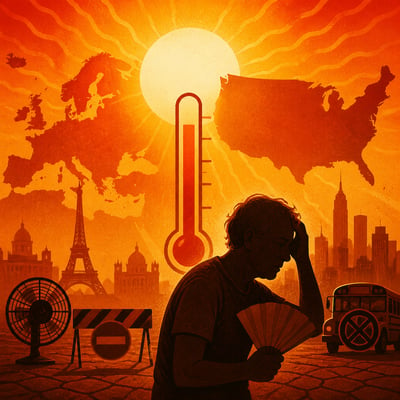
A series of severe heatwaves has driven record temperatures, excess deaths, and widespread disruptions across Europe and the United States. Officials and health agencies have reported fatalities, emergency alerts, school and transport interruptions, and temporary closures of major public sites as extreme heat spread across large regions. The coverage consistently links these events to climate change and to gaps in heat preparedness, especially for older adults and people without adequate cooling.

 Climate
 Privacy
 Bob Dylan
 Drones
 Data Centers
 AI Governance
 2026 Maine Senate Race