
Last Update: 06/03/2026 at 7:50 AM EST
Energy Storage And Clean Investment
Coverage from Reuters, Inside Climate News, and others
Articles
46
Latest Article
06/02
Active Days
132
Executive Summary
Global clean energy investment remains at record levels, with storage and electrification expanding quickly while grid constraints, tariff pressures, and policy uncertainty continue to shape where capital can be deployed.
Key Points
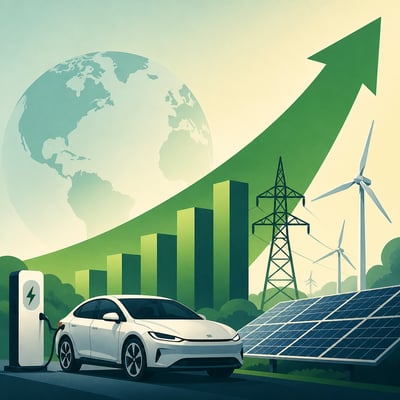
- Global clean energy investment has reached record levels, but the mix is shifting toward electrified transport, grids, and storage rather than only generation buildout.
- Stationary battery storage is growing rapidly, with annual additions now above 100 gigawatts globally and U.S. deployments setting new records in 2025.
- China remains the largest investor and storage deployer, while the United States is growing more unevenly under policy volatility and changing tax incentives.
- Battery manufacturers and automakers are repurposing some EV capacity toward stationary storage, but conversion costs, chemistry shifts, and supply-chain rules slow the transition.
- Utility-scale storage and grid infrastructure are increasingly tied to renewable integration, data-center load growth, and power-system reliability.
- Current investment levels still fall short of modeled net-zero needs, so the central gap is not momentum but scale and deployment speed.
- Transmission bottlenecks, interconnection delays, and permitting friction continue to limit how fast capital can turn into operating infrastructure.
Featured Article
American Clean Power Association and Wood Mackenzie report record 2025 U.S. battery storage growth, with 18.9 GW installed and over 28 GW projected by 2031.
Coverage Timeline: 132 Days
Hover over any logo to see coverage summary, click for full article.
Additional Articles
⭐⭐⭐⭐⭐
GM, Ford, and LG Energy Solution are shifting U.S. battery manufacturing toward stationary storage as AI-driven electricity demand grows, while projected storage demand fails to absorb EV battery oversupply this decade.
BloombergNEF reported in January 2026 that global energy-transition investment reached $2.3 trillion in 2025, led by electrified transportation spending.
RFF reports Global Energy Outlook 2025 shows global energy futures through midcentury with rising renewable deployment and emissions trajectories dependent on policy ambition.
Vistra Corp. cleanup of the Moss Landing lithium-ion battery fire continues as California implements new storage safety rules and a U.S. bill proposes battery stress-testing funding.
BloombergNEF forecasts stationary battery storage surpassing 300 gigawatts annually by 2036 after 112 gigawatts of annual additions in 2025, led by China.
Private markets have raised about 230 billion for energy transition funds worldwide over the past decade.
⭐⭐⭐
U.S. battery storage installations rose 30% in 2025 to 58 GWh, with around 60 GWh more expected in 2026 amid FEOC sourcing limits and component bottlenecks.
SEIA and Benchmark Mineral Intelligence reported 9.7 GWh of US energy storage additions in Q1 2026, driven by AI-driven demand and energy security needs.
US utilities in 2025 increased renewable electricity to 26%, and an EIA forecast projects 93% of 2026-2027 capacity additions from solar, wind, and batteries amid policy and court challenges.
EIA forecasts US utility-scale solar, wind, and battery storage growth through February 28, 2027, while fossil and nuclear capacity decline.
SEIA reports record U.S. battery storage installations in 1Q 2026 and projects 613 GWh by 2030 while warning that federal permitting delays could hinder deployment.
The International Energy Agency reported 108 GW of global battery energy storage added in 2025, led by utility-scale deployments and falling battery costs.
In Q1 2026, 49 U.S. states and Puerto Rico adopted 509 decarbonization and planning actions as large-load customer demand reshaped resource choices and tariff designs.
ACORE and S&P Global report policy and permitting uncertainty could slow U.S. solar, wind, and battery deployment as developers pursue expiring tax credits.
BloombergNEF analysis shows heat pumps among funded technologies as global clean energy investment reached 2.3 trillion last year.
E2 reported first-quarter 2026 clean energy project announcements in the USA, including Texas, totaling over 12 GW, alongside nearly 8 GW of canceled generation plans through March.
ACORE projected $120 billion renewable investment and up to 62 GW new U.S. capacity in 2026, citing tax-credit uncertainty and slow interconnection as key constraints.
US battery energy storage developers report scaling constraints for AI data center demand due to grid interconnection queues and China-dependent battery material supply chains.
In California, the Energy Commission approved Levy Alameda, LLC for a 400 MW battery energy storage system in eastern Alameda County using Opt-In Certification, with construction planned to start May 2027.
EIA projects U.S. summer 2027 power-sector natural gas consumption at 46.1 Bcf/d as ERCOT and PJM demand rises from data centers and manufacturing.
CIBF 2026 in Shenzhen (May 13-15, 2026) featured energy-storage battery advances, including 587Ah/588Ah mainstream cell specifications and growing 600Ah-plus and sodium-ion productization.
TrendForce data for Q1 2026 shows global energy storage cell shipments rising to about 224 GWh, with CATL holding a 22% share amid higher supplier concentration.
U.S. states including Iowa, South Dakota, New Mexico, and California increased wind and solar electricity shares in 2025 as battery storage expands grid integration.
Jason Kaminsky said data center power demand growth in the United States is pushing more renewable energy paired with battery storage, despite interconnection and permitting delays.
California recorded a battery discharge record above 12,000 megawatts in late March, supplying over 40% of demand and strengthening evening peak power as solar output declines.
In the United States, clean energy expansion depends on transmission lines, battery storage, and digital grid cybersecurity alongside solar and wind generation.
In 2025, global clean energy investment exceeded $2.3 trillion while the United States cancelled about $35 billion in clean energy projects amid policy changes favoring fossil fuels.
Wood Mackenzie reported 18.9 GW of U.S. battery storage installed in 2025, rising 52% from 2024, with federal tax credits and California net billing tariffs driving growth.
Wood Mackenzie reported 18.9 GW/51 GWh of U.S. energy storage installed in 2025, while FEOC foreign-input rules and load growth assumptions shaped outlook through 2031.
Anza Renewables reported Q1 2026 U.S. energy storage pricing divergence, with utility-scale battery costs dropping up to 20.9% since May while DG prices stayed mostly flat since November.
In 2025, Benchmark Mineral Intelligence reports global BESS installations exceed about 315 GWh, expanding lithium demand beyond EVs toward grid and data center storage.
Wood Mackenzie reported US energy storage deployments of 18.9 GW and 51 GWh in 2025, up 52% from 2024, with forecasts for 2026-2031 shaped by incentives and interconnection constraints.
American Clean Power Association and Wood Mackenzie report US battery storage installations exceeded 18GW in 2025, with record 5.8GW Q4 and a 500GWh 2026-2031 forecast.
Rhodium Group reported that global clean energy manufacturing investment fell 42% to 155 billion in 2025, driven by declines in China and weakened US policy incentives.
The U.S. electricity gap widens as data center and industrial demand grows faster than generation and transmission capacity, supporting further price increases.
U.S. electricity projections through 2027 point to solar-driven renewable growth and a rapid expansion of battery storage.
In April 2024, the Biden Administration announced initiatives to accelerate U.S. electric transmission deployment, aiming to reduce grid bottlenecks for electrification and clean energy investment.
As federal solar and wind tax credits phase out through 2027, U.S. states with stable incentives are positioned to attract more solar projects.
Rewiring America highlights battery storage, solar, and heat pumps in California, Virginia, and other U.S. states as virtual power plants coordinate distributed resources amid rising sea-level risk for New Orleans.
⭐️⭐️
BloombergNEF reports global energy transition investment rose to $2.3 trillion in 2025, led by electrified transportation and strong U.S. grid spending across China, the United States and Germany.
In 2025, Wood Mackenzie reported record U.S. battery storage deployments of 18.9 GW/51 GWh, while FEOC rules and demand growth drove forecast uncertainty through 2031.
Wood Mackenzie reported record 2025 U.S. energy storage installations of 18.9 GW and 51 GWh, while foreign entity restrictions and load assumptions drive forecast uncertainty through 2031.
BloombergNEF reports global energy transition investment reached $2.3 trillion in 2025, led by EVs, grid upgrades, and batteries across China, EU, and USA.
KBIGI reports global energy transition investment at 2.3 trillion USD in 2025 as renewables and storage drive grid expansion.
The Renewable Energy Institute reports US solar-led renewable capacity growth in 2025 and forecasts renewables plus batteries dominating new US electricity capacity in 2026.