
Last Update: 06/03/2026 at 4:25 AM EST
Global Warming Records And Outlook
Coverage from World Meteorological Organization, Inside Climate News, and others
Articles
39
Latest Article
06/02
Active Days
443
Executive Summary
Recent WMO reporting shows the climate system remains at record warmth, with 2025 among the hottest years, ocean heat at extreme levels, and continued sea-level rise and ice loss. Near-term forecasts keep 1.5 C exceedance likely within the next five years.
Key Points
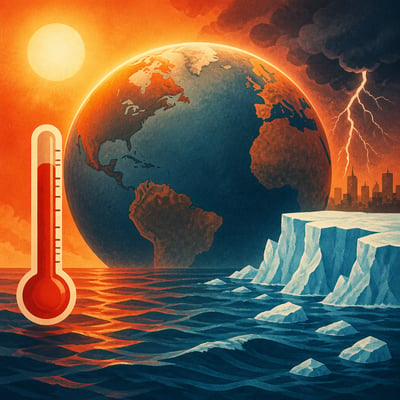
- Global temperature records remain near the top of the historical range, with 2025 repeatedly described as among the warmest years observed.
- Ocean heat content is one of the clearest persistent signals, with records or near-record values across the latest reporting and most excess heat stored in the oceans.
- Greenhouse gas concentrations continue to rise, and WMO framing links that buildup to a persistent Earth energy imbalance.
- Sea level, glacier mass loss, and Arctic sea-ice decline remain aligned across the material as continuing long-term indicators of change.
- Marine heatwaves, heat stress, drought, flooding, wildfires, and tropical cyclones appear as recurring impact channels rather than isolated events.
- Near-term projections point to a high probability of at least one year above 1.5 C between 2026 and 2030, with a record-hot year likely before the decade ends.
- The cluster is coherent and stable: most items reinforce the same monitoring storyline rather than introducing competing explanations.
Featured Article
WMO published the State of the Global Climate 2025 report, concluding record energy imbalance and ocean heat uptake are amplifying greenhouse-gas-driven risks for centuries.
Coverage Timeline: 443 Days
Hover over any logo to see coverage summary, click for full article.
Additional Articles
⭐⭐⭐⭐⭐
WMO reported 2015-2025 as the hottest 11-year period on record, citing record Earth energy imbalance, ocean heat content, sea-ice loss, and health-linked cascading extremes in 2025.
WMO reported hydrological whiplash and record heat in Latin America and the Caribbean, citing drought and extreme rainfall impacts across Mexico, Peru, Ecuador, and Jamaica in 2025.
Global temperatures in 2025 rose to about 1.44C above pre industrial levels worldwide, with record ocean heat content and sea level rise.
The World Meteorological Organization announced in Geneva that 2025 ranked among the three warmest years on record globally, based on eight consolidated temperature datasets.
WMO reports 2024 as the warmest year on record, driven by greenhouse gas emissions and El Nino, with global ocean warming and rising sea levels.
WMO forecast a moderate to strong El Nino through November starting June, signaling higher drought, heavy rainfall, and heatwave risks across multiple regions.
WMO forecasts a 91% chance that global temperatures will exceed 1.5C above 1850-1900 for at least one year between 2026 and 2030, with El Nino increasing record-year odds.
WMO reports an 86 percent chance of a record-warm year within five years and a 75 percent chance that 2026-2030 averages exceed 1.5C.
WMO State of the Global Climate 2025 reports 2025 remained among the hottest years on record as greenhouse gases and ocean heat continued to rise worldwide.
WMO 2025 climate indicators show record greenhouse gases and accelerating ocean heat uptake, driving widespread marine heatwaves, sea level rise, and cryosphere decline.
World Meteorological Organization reports 2025 Earth energy imbalance reaches a modern record level, with ocean heat uptake accelerating extreme weather and sea-level risks.
⭐⭐⭐
WMO reported record warmth and accelerating ocean and ice losses in 2025 findings on global climate imbalance.
WMO reported in 2025 climate indicators that ocean heat and atmospheric CO2 reached records and introduced Earth energy imbalance, showing maximum heat storage since 1960.
World Meteorological Organisation forecasts very high likelihood of the hottest year on record before 2030 amid near-record global temperature levels.
António Guterres cited a World Meteorological Organization State of the Global Climate report describing record Earth energy imbalance, greenhouse gases, and ocean heat buildup.
UN Secretary-General António Guterres cited World Meteorological Organization findings on record Earth energy imbalance and greenhouse gases during release of the State of the Global Climate report.
World Meteorological Organization reported record 2025 heat trapping, ocean heat content, and Earth energy imbalance, projecting continued ocean warming and sea-level rise for centuries.
WMO reported 2025 as the second- or third-hottest year, citing 1.43 C warming above pre-industrial levels and accelerating ocean heat driving sea-level rise and extreme-weather impacts.
The UN and World Meteorological Organization report 2015-2025 as the hottest period on record, citing accelerating warming, record ocean heat, and intensifying extremes in 2025.
World Meteorological Organization assessment released in Geneva in the 2020s finds 2015-2025 as the warmest period since 1850 and 2025 as the second or third hottest year.
On March 23, the World Meteorological Organization warned that greenhouse-gas forcing plus a likely El Niño could drive record heat into 2027.
WMO reports record 2025 planetary energy imbalance and continued greenhouse gas increases, warning that ocean heat uptake will sustain climate impacts for centuries.
The WMO and UN officials reported 2025 record Earth energy imbalance and ocean heat content, projecting long-lasting sea-level rise and ecosystem impacts.
WMO reported that 2015 to 2025 was the hottest 11-year stretch on record, citing 2025 near-record warmth, record energy imbalance, and accelerating ocean-driven impacts.
WMO reported 2015-2025 as the hottest 11 years since 1850, with 2025 second or third hottest and major glacier losses in Iceland and North America.
WMO data reported by Reuters in 2025 shows global average warming near 1.43 C above pre-industrial levels and record glacier melting in Iceland and North America.
UN weather agency reported 2015-2025 as the hottest on record while citing severe glacier mass loss and a Western Cape heatwave.
WMO reported record warmth and a new high Earth energy imbalance in 2025, driven by greenhouse gases and concentrated ocean heat uptake.
WMO State of the Global Climate reporting for 2025 finds record warming, record ocean heat, and attribution of severe events to human greenhouse-gas emissions.
WMO warns greenhouse-gas-driven energy imbalance is causing record warmth and ocean heat uptake, with probable El Niño conditions expected in late 2026.
World Meteorological Organization reporting shows 2025 among the warmest years as record ocean heat and low polar ice accompany attribution of severe events to human-driven climate change.
The World Meteorological Organisation reported from Geneva on March 23 that 2015-2025 was the hottest 11-year period since 1850, with 2025 ranking second or third.
The WMO reported in 2025 that a record Earth energy imbalance is storing most excess heat in oceans, driving unprecedented warming and extreme weather risks.
António Guterres declared a climate emergency after the World Meteorological Organization released the State of the Global Climate report, citing record energy imbalance and ocean heat accumulation.
World Meteorological Organization reported record ocean heat content in 2025, driven by greenhouse-gas energy imbalance, with continued century-scale Southern Ocean warming.
WMO released the State of the Global Climate 2025 report on World Meteorological Day, citing record warmth, record ocean heat content, and major extreme weather impacts in 2025.
World Meteorological Organization scientists reported record greenhouse gas concentrations and record heat in 2015 to 2025, highlighting accelerating energy imbalance and ongoing sea-level rise drivers.
⭐️⭐️
World Meteorological Organization State of the Climate reporting shows sustained Earth energy imbalance dominated by ocean heat uptake, with cascading risks for sea level and extremes.