

Last Update: 06/03/2026 at 6:50 AM EST
Heat Pump Costs And Adoption
Coverage from The Guardian, The Independent, and others
Articles
69
Latest Article
05/21
Active Days
139
Executive Summary
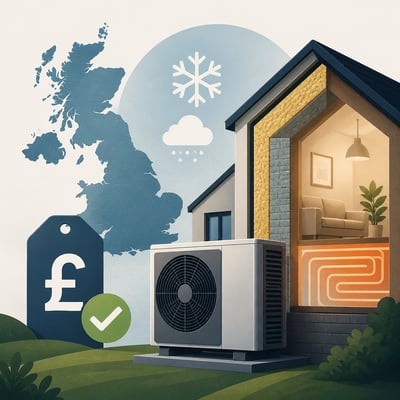
Heat pumps are gaining traction as a low-carbon heating option, but their value still depends heavily on home suitability, electricity prices, insulation, and subsidies. Recent coverage emphasizes practical adoption, cold-weather performance, and ongoing debate over real-world savings versus gas and oil systems.
Key Points
- Recent coverage repeatedly frames heat pumps as a practical replacement for oil, LPG, and older electric heating, while savings versus gas remain smaller and more sensitive to tariffs.
- Upfront costs remain a major barrier, but grants and rebates such as the UK Boiler Upgrade Scheme and Scottish support programs materially improve household economics.
- Cold-climate performance is a persistent theme: inverter-driven systems, defrost cycles, and base-pan heating are presented as key features for reliable winter operation.
- Home suitability matters as much as the equipment itself; insulation, radiator sizing, flow temperatures, available space, and planning restrictions often determine outcomes.
- A clear split remains between optimistic efficiency claims and cautionary consumer experience, with some coverage noting higher running costs or disappointing savings in real homes.
- Air-source heat pumps dominate the material as the most practical retrofit option, while ground-source systems appear as higher-cost, site-dependent alternatives.
- The topic is mostly structural rather than event-driven: the same economic and technical constraints recur across household guides, policy explainers, and vendor material.
Featured Article
A UK home-improvement explainer outlines in the 2020s how government-backed heat pumps can replace gas boilers in England and Wales.
Coverage Timeline: 139 Days
Hover over any logo to see coverage summary, click for full article.
Additional Articles
⭐⭐⭐⭐⭐
The UK Labour government on 20 January 2026 announced a 15 billion pound Warm Homes Plan prioritizing heat pump incentives over a gas boiler phaseout.
In the UK in 2026, the Labour government unveiled the Warm Homes Plan, shifting from insulation mandates to incentive-based support for residential heat pumps and other green technologies.
The Independent publishes a 2020s UK guide explaining domestic air- and ground-source heat pump economics, installation steps, and Boiler Upgrade Scheme grants for homeowners.
UK start-up Luthmore recently secured a total of 12.4 million pounds to commercialise a battery-powered electric boiler positioned across Britain as a lower-disruption alternative to residential heat pumps.
A UK home-improvement guide from The Independent explains in 2025 how domestic air- and ground-source heat pumps compare economically with gas boilers, including grants and installation steps.
In the 2020s UK market, Octopus Energy's Cosy air-source heat pump is evaluated as a grant-eligible, smart-tariff integrated alternative to gas boilers.
In 2024 in Britain, rapidly growing heat pump adoption is being driven by government Boiler Upgrade Scheme grants and Octopus Energy's Cosy heat pump offering.
Resolution Foundation analyzes the UK Government's January 2026 Warm Homes Plan, highlighting implications for heat pump deployment, funding design, and regulation across England.
The UK government unveils the Warm Homes Plan now to fund heat pumps, solar panels, and batteries nationwide through low interest loans and free upgrades.
In Britain, a Times column in the 2010s explains heat pumps as reverse refrigerators and discusses electricity price and policy implications for adoption.
Newark Cylinders and Heat Geek detail in a 2025-2026 UK homeowner guide how proper maintenance, controls, and upgraded cylinders improve air source heat pump winter performance.
A UK-focused explainer published in the 2020s describes how air-source heat pumps and smart, solar-integrated controls can efficiently heat homes using ambient air and low flow temperatures.
The UK government has launched the Warm Homes Plan, offering universal 7,500 pound heat pump grants nationwide as part of a coordinated retrofit programme to cut bills and fuel poverty.
In 2026, UK underfloor heating specialists describe low-temperature water systems paired with air-source heat pumps becoming standard in urban retrofits due to regulations and grants.
The Independent details how UK households can use efficient heat pumps, smart tariffs, insulation, and the Boiler Upgrade Scheme to manage heating bills and emissions compared with conventional boilers.
A UK home-improvement guide compares air source and ground source heat pumps, outlining differences in efficiency, costs, space needs, and suitability for various properties.
On January 16, 2026 in the UK, start-up Luthmore unveiled funding and plans for a battery-electric boiler competing with subsidised residential heat pumps.
A narrative explainer published in the 2020s examines in the United Kingdom why residential air-source heat pump reliability and costs vary widely across homeowners.
Researchers in northern Italy monitored a swine farm hybrid heating system from November to April using PVT solar, borehole storage, and a dual-source heat pump.
⭐⭐⭐
In the UK, residential air-source heat pumps cut heating electricity demand after insulation upgrades and low-temperature heating distribution alignment, but economics depend on electricity tariffs and upfront costs.
Luthmore in Wiltshire develops a battery powered electric boiler to replace gas combi boilers in space constrained UK homes, backed by 35.5 million pounds in the 2020s.
The Independent publishes a 2020s consumer guide for UK homeowners on choosing, sizing, and funding residential heat pump systems, including the Boiler Upgrade Scheme grant.
The Independent explains in 2020s UK coverage how air-source heat pump savings vary by replaced fuel, insulation, controls, and available Boiler Upgrade Scheme grants.
The United Kingdom government unveils a 15 billion warm homes plan offering zero interest loans and large heat pump grants to households.
UK Censuswide survey finds 66 percent of heat pump users pay more to heat homes than gas boilers, despite government subsidies.
UK government pledges 15 billion pounds over five years to expand heat pumps in homes.
Northern Michigan residents are advised to consider electric heat pumps for whole home heating to reduce emissions and costs compared with wood burning or gas fireplaces.
UK households rely on heat pumps for cold spell comfort and lifecycle based, low carbon construction.
Luthmore unveils a battery powered electric boiler in the United Kingdom to replace gas combi boilers as policy reviews consider including electric boilers in upgrade schemes.
UK government unveils 15 billion pound Warm Homes Plan on Jan 21, 2026, funding loans and grants to install heat pumps, solar and batteries across the United Kingdom.
During a UK trial, Worcester Bosch and the University of Salford report that a hybrid heat pump system can meet most annual heat demand in typical UK homes.
The UK government unveils the Warm Homes Plan in January 2026 to install heat pumps and renewables in up to 5 million homes.
Homeowners in 2026 adopt heat pump based upgrades in the United Kingdom to reduce energy bills and improve comfort through insulation, renewables, and smart controls.
In Frederick Maryland, Smock Heating & Air outlines seven steps for installing heating systems, highlighting heat pump options for balanced performance and energy efficiency.
Installer John Rowe and Efficiency Vermont report increased cold-climate air-source heat pump adoption across Vermont in recent years, aided by rebates and weatherization programs.
The comparison of heat pumps and gas heating for US homes and industry emphasizes electricity-price sensitivity, efficiency-driven cost advantages, and limits of hydrogen for residential heating.
In U.S. residential HVAC discussions, a technician highlights modern heat pumps for efficiency, quiet operation, variable-speed temperature control, and sub-freezing heating without combustion.
A commentary on heat pump heating argues installations show lower energy use than boilers and reduced oil dependency as electricity supply shifts.
⭐️⭐️
Property listings in England and Wales in January 2026 feature air source heat pumps and solar panels.
The UK Boiler Upgrade Scheme offers a 7500 pound grant for air source or ground source heat pumps in England and Wales.
UK homeowners should obtain a professional heat loss survey to determine if an air source or ground source heat pump best fits the home.
England and Wales households can access up to 7500 pounds for air source heat pumps through the Boiler Upgrade Scheme, with Octopus Energy managing eligibility, grant application, and installation since 2022.
A four bedroom home in Liverpool replaced a gas boiler with an Octopus Cosy 9 heat pump in April, aided by a 7500 pounds government grant.
UK government launches the Warm Homes Plan in England to fund heat pumps and other upgrades for households by 2030.
In the United Kingdom in 2024, a Censuswide survey shows heat pumps are growing in adoption but may raise household heating costs.
The article explains how heat pump systems reduce electricity use while providing year round heating and cooling in homes in Portland Oregon.
UK homeowner assesses heat pump viability in a conservation area and finds air source heat pump impractical due to back placement and access.
Americans adopt heat pumps in the United States during the 2020s to lower heating costs and carbon emissions.
Homeowners in 2026 should consider smart heat pump upgrades for residential settings.
Buffalo New York homeowners installed a 3-ton InverterCool Ultra heat pump to maintain 68F indoors during sub-zero early 2025 weather, avoiding electric heat strips.
Homeowners are increasingly installing heat pumps before the holidays to ensure reliable, comfortable heating during winter.
AIROSD presents a global portfolio of heat pump systems including water ground source, air source, pool, hot water, and drying heat pumps to deliver high efficiency and lower energy use.
Industry stakeholders report hot water heat pump systems replacing boilers in New Zealand buildings in 2026.
In 2026, U.S. homeowners adopt ductless mini split upgrades for efficiency and reliability.
Scottish households can check eligibility for Warmer Homes Scotland in Scotland and access free advice on heat pump upgrades.
Paul Hope explains heat pump options for home upgrades in a Consumer Reports YouTube Short, comparing ducted and ductless setups and highlighting energy savings.
US households switch to heat pump water heaters to reduce energy use and lower annual bills.
Experts say heat pumps can slash home energy bills nationwide, with federal incentives expiring this year.
In 2024, a Cleveland homeowner installed five ductless heat pumps and two outdoor units to replace a 35-year-old gas furnace.
Renee documents heat pump installations in a garage and a shed during home renovation, highlighting energy savings and leasing options.
Canadian homeowner reports heat pump performance and energy savings in Canada during the summer after installation.
A northeast Ohio homeowner seeks guidance after three contractors discourage a heat pump upgrade and recommend insulation and weatherproofing first.
Homeowners in the United States are urged to consider air source heat pumps now as a cost effective alternative to rising furnace prices and higher heating costs.
Homeowners and installers increasingly promote electric heat pumps to replace oil or furnace heating in the U.S., citing efficiency gains and varying cold-weather performance.
Massachusetts residents discuss heat pump performance in a frigid New England winter.
A US homeowner reports a heat pump reducing heating costs during a period of rising gas prices.
HVAC experts say heat pumps remain cost effective after tax credit reductions in the United States, with single zone ductless mini splits highlighted as a leading option.
A homeowner in climate zone 4a replaced oil heating with electric heat pump systems in 2022, reporting winter savings of about 300 dollars per month.