History
07/23/20260 new articles
The story broadens from xAI’s power choices to a wider framing of AI electricity demand as an increasingly important constraint on U.S. growth. It also adds a sharper contrast between terrestrial solar as a practical option and Musk’s orbital data-center vision as the more prominent, but still highly uncertain, alternative.
07/23/20260 new articles
The story now places sharper emphasis on xAI’s operational power mix, adding that its Megapack use has grown to nearly $1 billion and that emissions/permitting scrutiny is intensifying. It also newly identifies legal pressure from NAACP and Earthjustice, while the broader framing shifts toward an explicit power-supply bottleneck for AI.
- xAI’s Megapack spending is reported to approach $1 billion since 2024.
- Memphis and Mississippi sites rely on dozens of natural-gas turbines.
- NAACP and Earthjustice are reportedly seeking legal action.
- Terrestrial solar-and-battery projects remain early-stage deployments.
07/22/20260 new articles
The story broadens from Musk’s gas-and-battery AI power strategy versus orbital solar into a wider power-supply contest that now includes terrestrial solar-and-battery alternatives and explicit legal pushback. The current version also makes the pollution and permitting conflict more central than before.
- Ambrosia Energy is developing modular solar-and-lithium-ion plants for continuous supply.
- NAACP and Earthjustice are reportedly pursuing legal action over xAI pollution.
- Permitting and emissions concerns are now central to the story.
- Terrestrial solar-and-battery systems are presented as an active alternative.
- Tesla Energy is named more specifically as the Megapack supplier.
06/29/20261 new articles
The main update is that the story has shifted from describing Musk-linked AI power choices in general to a more explicit contrast between near-term fossil/battery power and a speculative orbital solar future. The new version also adds the broader claim that electricity supply, not chips, is the key AI bottleneck.
06/05/20263 new articles
The story has shifted from a mostly speculative debate about orbital AI power to a more concrete account of how Musk-linked AI infrastructure is being powered today. xAI’s reliance on natural gas turbines and Tesla Megapacks is now central, while SpaceX’s space-solar concept remains a future-facing alternative rather than the main operating reality.
- xAI is relying in part on natural gas turbines for data-center power.
- Tesla Megapacks are being used to buffer grid electricity at Colossus.
- Permitting, emissions, and enforcement concerns are recurring in the reporting.
- EPA is now referenced in connection with turbine enforcement and loophole closure.
- SpaceX’s orbital solar idea is framed as a future option, not a current plan.
05/23/2026Topic Formed
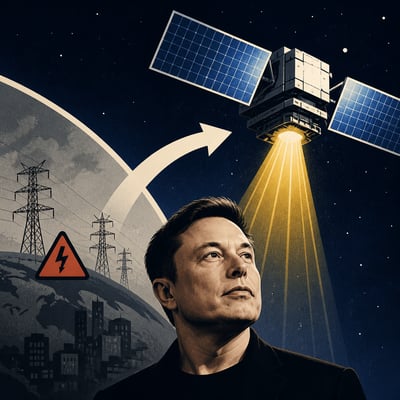
Elon Musk is increasingly framing AI power needs as a space infrastructure problem, promoting solar-powered orbital data centers as a way to bypass terrestrial grid limits. The reporting contrasts that vision with practical obstacles including heat management, satellite reliability, launch costs, and debris risk. Across the material, Musk also continues to emphasize electricity constraints on AI growth on Earth while giving much less visible support to conventional terrestrial solar deployment.

 Climate
 Privacy
 Bob Dylan
 Drones
 Data Centers
 AI Governance
 2026 Maine Senate Race