
Last Update: 06/03/2026 at 5:25 AM EST
Offshore Wind Policy And Grid Tension
Coverage from Los Angeles Times, Planetizen, and others
Articles
9
Latest Article
05/25
Active Days
64
Executive Summary
Recent coverage shows a sharp split between offshore wind expansion efforts and federal actions that slow or reverse them. California is advancing major port and grid infrastructure for floating offshore wind, while Washington has canceled support, reopened legal conflict, and pushed developers toward fossil fuel alternatives. At the same time, wind and solar continue to grow globally, strengthening the view that variable renewables are expanding but remain constrained by permitting, financing, and reliability questions.
Key Points
- California is pushing major offshore wind infrastructure forward, led by the $4.7 billion Pier Wind terminal at the Port of Long Beach.
- Federal policy is moving in the opposite direction, including lease cancellation deals, funding cuts, and pressure on developers to abandon offshore wind projects.
- Legal and regulatory conflict remains active, with court rulings affecting permitting and lease activity.
- Wind and solar generation continues to expand globally and in the U.S., even as policy resistance slows some projects.
- Reliability and system integration remain persistent issues, especially around weather-dependent output, storage limits, and transmission buildout.
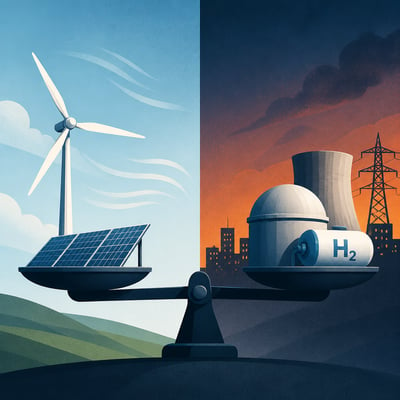
- Clean firm power is appearing as a recurring countertheme, with nuclear, hydrogen, geothermal, and CCS described as possible complements to renewables.
- Several pieces frame renewables as lowering fuel-price exposure, while others argue they increase cost, land, and backup requirements.
Featured Article
In a 2025 Department of the Interior deal, TotalEnergies offshore wind development off the U.S. East Coast ended and 928 million dollars was redirected to fossil fuel projects.
Coverage Timeline: 64 Days
Hover over any logo to see coverage summary, click for full article.
Additional Articles
⭐⭐⭐⭐⭐
The Port of Long Beach is advancing the $4.7-billion Pier Wind offshore wind terminal as federal payouts pay lease holders to abandon offshore wind plans.
Ember reported that wind and solar generation exceeded natural gas worldwide for the first time in April 2026, with 532 TWh versus 477 TWh.
⭐⭐⭐
Port of Long Beach plans a $4.7 billion Pier Wind offshore wind terminal in California to stage floating turbines for federal lease areas off Morro and Humboldt bays.
In Louisiana and the U.S. Southeast, natural gas fuel charges linked to extreme weather can raise electricity bills, while wind and solar reduce fuel-cost volatility.
U.S. clean firm resources are argued to reduce grid cost and risk by complementing solar and wind, supported by federal tax-credit eligibility rules and examples across nuclear, hydrogen, geothermal, and CCS.
The article claims U.S. federal actions under Donald Trump reduced wind subsidies and blocked turbine projects while climate mitigation depends on shifting from coal and gas to renewables.
Low-wind periods in Britain reduce wind generation, increasing gas dispatch and creating reliability risks for power supply and emissions.
Within the MISO grid and broader U.S. planning context, critiques of wind and solar cite intermittency-driven backup, storage, transmission, and land requirements for reliability.