
 Climate
 Privacy
 Bob Dylan
 Drones
 Data Centers
 AI Governance
 2026 Maine Senate Race
Rajasthan Builds Smarter Renewable Grids
Coverage from Reuters, ETEnergyworld, and others
Articles
6
Active Days
88
The Topic
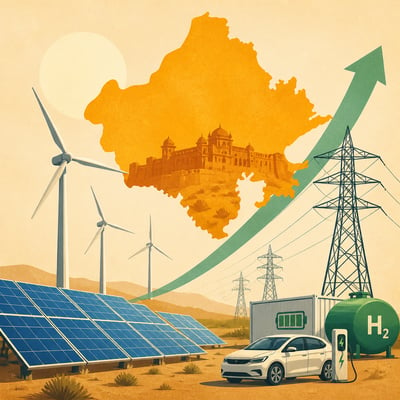
Rajasthan is expanding solar, wind, and distributed renewable generation while upgrading transmission and distribution systems to integrate that power reliably. Transmission delays have left about 60 GW of projects awaiting grid links, increasing the importance of stronger networks, battery storage, smart metering, and digital tools such as grid digital twins. State plans and an agreement with the International Solar Alliance aim to coordinate renewable expansion, grid modernization, and energy management through 2030 and beyond.
First Article: 04/13/26
Latest Article: 07/09/26
Summary
- About 60 GW of Rajasthan renewable projects are awaiting transmission links, while connectivity applications total roughly 130 GW and planned or developing transmission covers about 73 GW.
- The state is targeting 125 GW of clean energy capacity and is positioning solar, wind, storage, green hydrogen, and distributed generation as pillars of its energy strategy.
- Rajasthan and the International Solar Alliance signed a framework for a 2030–35 energy transition plan focused on grid modernization, storage, efficiency, and institutional capacity.
- Digital twins, smart metering, feeder monitoring, and predictive maintenance are being used to improve renewable integration, reliability, and visibility across distribution networks.
- Jodhpur Discom is pairing PM-KUSUM and rooftop solar growth with stronger substations, feeder segregation, digital monitoring, and planned battery storage.
- The central tension is shifting from adding renewable generation to moving and managing it across the day, especially when solar output falls after daylight hours.
History
The story now has a more concrete planning-and-implementation layer: Rajasthan’s renewable buildout is tied to a signed 2030–35 transition framework with the International Solar Alliance and a specific distribution utility’s upgrade efforts. It also sharpens the grid bottleneck by quantifying both pending connectivity demand and transmission buildout.
The story has shifted from broad renewable expansion constrained by transmission to a more specific operational challenge: making Rajasthan’s grid ready to absorb and manage much higher solar penetration. The emphasis now includes concrete modernization measures such as smart meters, digital twins, storage, and utility-level network upgrades.
Featured
Timeline: 88 Days
Hover over any logo to see coverage summary, click for full article.