
 Climate
 Privacy
 Bob Dylan
 Drones
 Data Centers
 AI Governance
 2026 Maine Senate Race
EV Batteries Expand Grid Storage
Coverage from New Scientist, WebProNews, and others
Articles
8
Active Days
36
The Topic
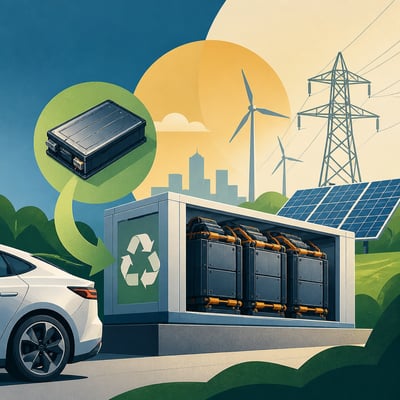
Electric-vehicle batteries are becoming more closely integrated with electricity storage through several routes: sodium-ion cells are entering early EV and stationary applications, retired lithium-ion packs are being reused, and bidirectional charging could allow parked vehicles to support homes and power grids. Stationary storage is also becoming a more important source of battery demand as utilities, data centers and renewable-energy systems require flexible capacity. The direction is promising but remains dependent on cost, safety certification, charging standards, battery performance and reliable end-of-life management.
First Article: 06/04/26
Latest Article: 07/09/26
Summary
- Sodium-ion batteries are moving into early EV and grid-storage applications, with reported advantages in cold-weather performance, safety and material availability.
- Stationary storage is becoming a stronger source of lithium demand as grid upgrades, renewable generation and data-center electricity use increase.
- Retired EV batteries can retain roughly 70% to 80% of their original capacity and may be reused for grid services, backup power, mini-grids and charging systems.
- Bidirectional charging could turn parked EVs into distributed storage, with one estimate placing the usable battery pool at about 120 GWh compared with roughly 25 GWh in stationary systems at the beginning of 2026.
- Lithium remains dominant, particularly for higher-range and premium EVs, while sodium-ion is being positioned for lower-cost vehicles, extreme climates and stationary storage.
- Second-life projects face testing, disassembly, safety, traceability and end-of-life challenges, while falling prices for new batteries may weaken their economic case.
- Commercial progress remains uneven, with new projects and partnerships alongside supply-chain gaps and the closure of at least one sodium-ion developer.
History
The story now places much more weight on bidirectional charging and the broader role of stationary storage, not just repurposed batteries and sodium-ion demos. It also adds more concrete commercial and technical framing, including ISO 15118 timing, usable battery-pool estimates, and the weakening economics of second-life reuse.
The story has broadened materially beyond second-life EV batteries to include sodium-ion batteries as a parallel storage and EV pathway. It also adds new commercialization, standardization, and supply-chain dimensions, making the market look larger and more multi-technology than before.
Featured
Timeline: 36 Days
Hover over any logo to see coverage summary, click for full article.