
 Climate
 Privacy
 Bob Dylan
 Drones
 Data Centers
 AI Governance
 2026 Maine Senate Race
Last Update: 08/02/2026 at 3:00 PM EST
Rising Global Fire Weather Extremes
Coverage from Reuters, Nature, and others
Articles
18
Active Days
2774
The Topic
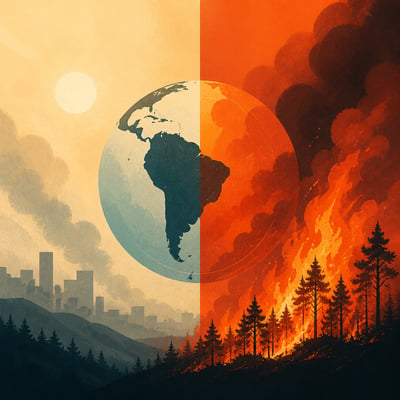
Recent studies consistently show that human-caused warming is increasing extreme fire weather worldwide, making fire-prone conditions more frequent, more synchronized across regions, and harder to manage. The strongest signal is in attribution research linking hotter, drier, windier conditions to larger burned areas and greater firefighting strain.
First Article: 12/13/18
Latest Article: 07/17/26
Summary
- Multiple studies now link rising fire weather extremes to human-caused warming rather than natural variability alone.
- The strongest recurring pattern is synchrony: fire-prone conditions are increasingly occurring at the same time across regions and countries.
- Regional evidence points to larger burned area when widespread extreme fire weather overlaps with hot, dry anomalies.
- The Americas, Europe, and parts of Africa and Asia all show heightened fire-weather risk, though the timing and drivers differ by region.
- Climate modes such as ENSO, the Indian Ocean Dipole, and related variability still shape year-to-year fire patterns on top of the warming trend.
- Operational pressure is increasing because overlapping fire seasons can strain firefighting resources and mutual aid across borders.
- Some coverage broadens from fire weather to broader extreme-weather attribution, reinforcing the wider human influence signal while remaining methodologically cautious.
History
This topic is new, but as new articles are added to it this area will summarize shifts, changes and expansions of the issues.
Featured
05-12-2026
World Weather Attribution researchers warn that warming and an anticipated strong El Nino may intensify drought-driven wildfire risk across Africa and Asia in 2026.
04-01-2026
Using ERA5, burned-area observations, and CMIP6 simulations, a European study attributes a 14.8% rise in synchronized extreme fire-weather extent over the past decade primarily to temperature changes.
02-18-2026
Researchers evaluate 1979 2024 fire weather data across GFED regions to attribute increases in synchronous fire weather to anthropogenic climate change.
Timeline: 2774 Days
Hover over any logo to see coverage summary, click for full article.
Additional Articles
⭐⭐⭐⭐⭐⭐⭐⭐
MIT scientists analyze global temperature responses to Pinatubo eruption 1991, Australian wildfires 2019-2020, and Hunga Tonga eruption 2022 to separate natural signals from anthropogenic warming.
⭐⭐⭐⭐⭐
Michael Diamond explains aerosol-cloud interactions and uncertainty in human-attributed warming, including ship-track effects and the cooling offset from sulfur pollution changes.
Researchers find a global anthropogenic signal increasing extreme fire weather days between 1980 and 2023.
MIT researchers identify natural event signals affecting global temperatures using satellite data from 1986 to present worldwide.
World Weather Attribution study links 2024 Amazon and Pantanal fires to anthropogenic climate change in South America.
World Weather Attribution released a February 2026 analysis concluding that human-driven warming greatly increased the likelihood of the catastrophic January 2026 wildfires in Chile and Argentinas Patagonia.
Canadian wildfire trends and 2023 wildfire smoke into the northern United States are attributed mainly to warming-driven increases in extreme fire weather rather than broad forest mismanagement.
Researchers report global synchronous fire weather days nearly tripled worldwide over 45 years due to fossil fuel driven climate change.
Researchers find climate change has increased global synchronous fire weather days since the late 20th century.
In a 2020s American Enterprise Institute commentary, a climate researcher outlines IPCC definitions and probability concepts to explain challenges in detecting and attributing changes in extreme weather.
World Weather Attribution researchers concluded in February 2026 that human-driven warming sharply increased January wildfire-weather risk in Chile and Argentinas Patagonia.
Researchers report on Feb 18, 2026 that synchronous fire weather across 14 regions has more than doubled globally from 1979 to 2024, driven mainly by human-caused warming.
⭐⭐⭐
IPCC AR6 assessments (2023) show human influence increasing extreme weather risk globally.
Experts and World Weather Attribution linked a March record-breaking U.S. Southwest heat wave to human-caused warming, as NOAA data shows increasing hot-weather records and rising billion-dollar disaster impacts.
⭐️⭐️
Researchers report climate driven wildfire surges across North America from 2023 to 2025 due to heat, drought, and atmospheric variability.