
 Climate
 Privacy
 Bob Dylan
 Drones
 Data Centers
 AI Governance
 2026 Maine Senate Race
Last Update: 08/01/2026 at 2:00 PM EST
Singlet-Fission Solar Efficiency Breakthroughs
Coverage from TechRadar, Futurism, and others
Articles
6
Active Days
51
The Topic
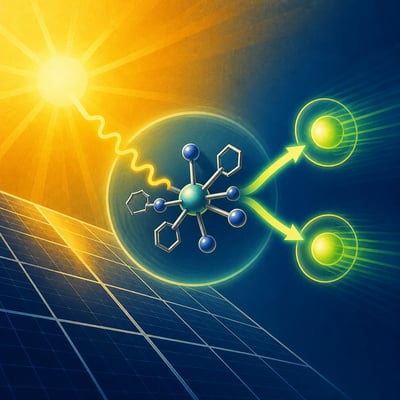
Recent research reports a singlet-fission photovoltaic approach that uses tetracene and molybdenum-based spin-flip emitters to capture triplet excitons, with lab quantum yields reaching roughly 110% to 130%. The signal is coherent and strongly centered on proof-of-concept materials science, but the main uncertainty remains whether the chemistry can be translated into solid-state solar devices.
First Article: 03/28/26
Latest Article: 05/17/26
Summary
- Multiple reports describe the same basic laboratory approach: tetracene generates split excitons and a molybdenum-based spin-flip emitter captures them.
- The repeated headline result is quantum yield around 110% to 130%, framed as more excitons per absorbed photon rather than energy created from nothing.
- The work is explicitly aimed at overcoming losses tied to the Shockley-Queisser limit and reducing energy waste in conventional photovoltaics.
- The main technical bottleneck is translation from solution-based experiments to solid-state or device-relevant solar-cell conditions.
- Triplet exciton capture and suppression of competing loss pathways, including Förster resonance energy transfer, are recurring mechanisms across the coverage.
- The evidence is dense but narrow: the cluster is highly coherent around one research direction and does not show broad policy, market, or deployment development yet.
History
This topic is new, but as new articles are added to it this area will summarize shifts, changes and expansions of the issues.
Featured
05-03-2026
Kyushu University researchers, with Johannes Gutenberg University Mainz, reported singlet-fission light conversion using a molybdenum spin-flip emitter in solution tests published in JACS.
04-12-2026
Japan and Germany researchers report a tetracene-molybdenum singlet-fission solar method using blue light, achieving about 130 percent lab conversion efficiency.
05-17-2026
Researchers at Kyushu University and Johannes Gutenberg University describe singlet-fission solar-cell architecture using tetracene and molybdenum exciton traps in photovoltaics.
Timeline: 51 Days
Hover over any logo to see coverage summary, click for full article.
Additional Articles
⭐⭐⭐
Kyushu University and Johannes Gutenberg University Mainz reported a molybdenum spin-flip emitter enabling singlet-fission exciton harvesting with about 130% quantum yield for solar-related systems.
Kyushu University and Johannes Gutenberg University Mainz researchers reported a molybdenum-based singlet-fission exciton-capture system with about 130% quantum yield in proof-of-concept tests.
A JACS-published study reports 130 percent quantum yield for a singlet-fission solar concept using tetracene and molybdenum-based complexes in lab tests.