History
07/23/20260 new articles
The story is reframed more explicitly as an energy-security response to Middle East disruption, with renewed emphasis on short-term stability rather than just long-term decarbonization. The current version also sharpens the scale of the renewable push and adds more detail on policy and market constraints.
07/22/20262 new articles
The story now extends beyond government-led renewable expansion to include major private-sector buildout for AI and semiconductor electricity demand, making industrial power needs a bigger driver of the transition. It also adds sharper evidence that execution is constrained by transmission delays, local resistance, and continued fossil and nuclear stopgaps.
- KKR and SK Inc. are building a 10-gigawatt renewable platform.
- The platform targets AI data centers and semiconductor manufacturing.
- Transmission delays and local resistance are now explicit constraints.
- Domestic-content rules are joined by planned carbon-footprint certification.
- Coal closures are delayed while nuclear generation is expanded.
06/29/20260 new articles
The story now frames South Korea’s renewable push as an energy-security response to the Iran crisis, rather than mainly a long-running deployment and infrastructure challenge. It also adds sharper evidence of political tension, with critics saying fossil-fuel support and coal reserve payments are still slowing the transition.
- Iran crisis is being used to justify faster renewable deployment.
- Grid-upgrade funding is rising alongside village solar loans.
- Domestic-content rules and import certification plans are being pushed.
- Critics say coal reserve payments still undercut the transition.
06/16/20263 new articles
The story has broadened from a domestic renewable buildout and grid-constraint narrative into a more detailed system-transition story that now includes offshore wind, port electrification, and supply-chain resilience. The main new emphasis is on implementation limits outside generation itself: grid congestion, domestic-content/import-certification measures, and infrastructure needs are now central to whether the plan can scale.
- Offshore wind is now a central planning focus.
- Ports are framed as energy hubs and demand centers for clean electricity.
- Domestic-content and import-certification measures target supply-chain dependence.
- Policy horizons now extend to 2035 in addition to 2030 and 2040.
- Southwestern grid congestion is described as a recurring deployment constraint.
05/18/2026Topic Formed
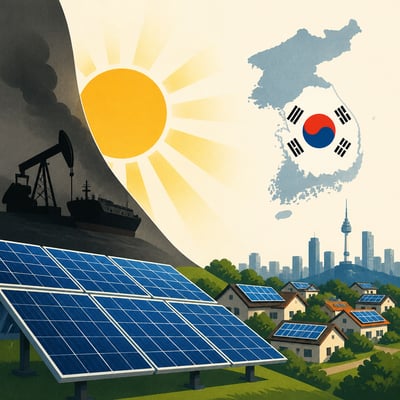
South Korea is moving faster on renewable energy, led by a large solar and wind expansion plan, village-scale solar income programs, and related financing measures. Grid bottlenecks, coal and nuclear balancing actions, and renewable curtailment issues show that implementation is still constrained.

 Climate
 Privacy
 Bob Dylan
 Drones
 Data Centers
 AI Governance
 2026 Maine Senate Race