
 Climate
 Privacy
 Bob Dylan
 Drones
 Data Centers
 AI Governance
 2026 Maine Senate Race
Trump Administration Blocks U.S. Wind
Coverage from The New York Times, The Guardian, and others
00/00/0000
Articles
67
Active Days
114
The Topic
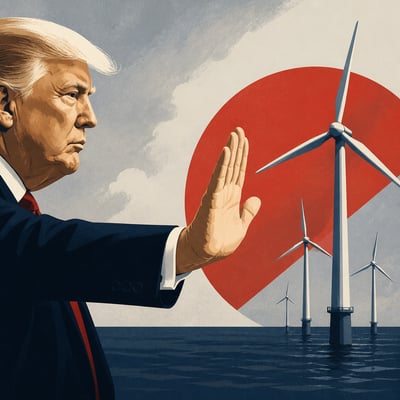
The Trump administration is using permitting delays, halted military reviews, and payments to terminate offshore wind leases to restrict U.S. wind development, while directing public support toward coal, natural gas, and selected alternatives such as geothermal energy. The actions have stalled or canceled projects across multiple states and coastal regions, putting billions of dollars in planned investment and associated jobs at risk. Lawsuits from renewable-energy groups and state governments are challenging the legality of several measures, while officials defend them as efforts to prioritize reliable and affordable power.
First Article: 03/19/26
Latest Article: 07/10/26
History
The core crackdown on wind remains the same, but the story now more clearly centers on offshore lease cancellations, reimbursements, and the growing legal fight over those actions. It also adds more explicit support for coal and natural gas as the administration’s preferred beneficiaries.
The story now puts more weight on the scale of the disruption and the policy’s broader energy-market implications, especially the job losses and the redirection of support toward fossil fuels and geothermal. It also sharpens the legal and stakeholder conflict by emphasizing opposition from renewable groups, states, and coastal regions facing supply and demand uncertainty.
The story has broadened beyond offshore wind buybacks into a wider federal campaign against wind power, including a large Pentagon-driven slowdown of onshore projects and explicit support shifts toward fossil fuels. The new emphasis on scale, costs, and grid impacts makes the intervention look larger and more consequential than before.
- Pentagon delays have affected 106 onshore wind projects in 21 states.
- Those delayed projects represent more than $47 billion in potential investment.
- Interior agreed to pay over $2.5 billion to terminate eight offshore wind leases.
- Invenergy will receive $765 million for surrendering four offshore leases.
- Federal support is shifting toward coal and natural gas while wind pathways are reduced.
The story has shifted from a broad rollback of offshore wind into a more specific picture of buybacks and review freezes being used to unwind projects, while states mount targeted legal challenges. The new emphasis is on California's litigation and the Defense Department review freeze as separate fronts in the fight over federal authority.
- Federal actions now include buyback payments to developers exiting offshore wind projects.
- California is preparing litigation over Morro Bay lease buybacks.
- Environmental groups are challenging a Defense Department review freeze.
- The review freeze is alleged to function as a de facto ban on new wind projects.
- State climate and economic goals are now a central stake.
The story has sharpened from a general offshore wind rollback into a more active federal campaign to unwind projects, with developers and trade groups now openly contesting the permitting freezes and reimbursement-linked cancellations in court. The framing also broadens more clearly toward fossil-fuel substitution, especially LNG and oil and gas.
- Wind developers and trade groups are filing lawsuits over permitting delays.
- Federal permitting freezes now include turbine-height clearance disputes.
- The policy is increasingly tied to LNG and oil and gas investment.
- Courts have already blocked some earlier stop-work efforts.
- The rollback is described as active, not merely emerging.
The story now places much more emphasis on a structured federal buyback scheme: offshore wind leases are being canceled in exchange for reimbursement deals and, in some cases, new fossil fuel or LNG investment commitments. It also adds clearer evidence that this rollback is spreading across multiple developers, while legal challenges continue to test the administration’s authority.
- Buybacks are linked to fossil fuel and LNG investment commitments.
- Similar settlements expanded to Bluepoint Wind, Golden State Wind, and Invenergy.
- Experts are questioning the authority and funding basis for the buybacks.
- The story now includes the California coast, Gulf of Maine, Texas, and the Midwest.
- Supporters now stress winter reliability and manufacturing investment more explicitly.
The story has broadened from offshore wind lease cancellations into a wider federal crackdown on wind development, adding onshore permitting freezes and military review delays. At the same time, court rulings are now a stronger counterweight, with some projects resuming or beginning to deliver power despite the rollback.
- Pentagon and FAA review freezes are delaying many onshore wind projects.
- Courts have allowed several offshore projects to resume or deliver power.
- Federal settlement money is being redirected toward oil and gas projects.
- American Clean Power Association is now a prominent industry voice in the story.
- The story now includes onshore wind bottlenecks across multiple states.
The story has sharpened from a general federal rollback of offshore wind into a more specific legal and fiscal fight over cancellation settlements, with states now directly suing the government over how those reimbursements are structured. The current version also centers the dispute more explicitly on Interior’s authority and the Judgment Fund, not just on project delays.
- New York and other Democratic-led states have sued over reimbursements and lease cancellations.
- The Judgment Fund is now a disputed financing mechanism in the settlements.
- The Outer Continental Shelf Lands Act is newly cited as part of the legal dispute.
- Offshore wind is now tied more explicitly to Northeast and PJM grid reliability.
- Doug Burgum is now repeatedly identified as a central policy actor.
The story has broadened from offshore lease buybacks and litigation to a clearer, more coordinated federal rollback strategy that includes payment deals, permitting freezes, and national-security reviews. It also now shows that some major wind projects are still operating or advancing despite the policy push.
- Payments are being negotiated or finalized to cancel offshore wind leases.
- Federal policy now includes permitting freezes and national-security review delays.
- Onshore wind capacity is being slowed alongside offshore wind.
- Vineyard Wind, Revolution Wind, and Coastal Virginia Offshore Wind are still operating or advancing.
The story now adds that federal courts are actively constraining some anti-wind efforts even as the rollback continues, and that the lease-exit approach may be turning into a repeatable settlement model. It also narrows the core geography and stakes around offshore wind’s ability to reach coastal grids, rather than a broader wind-permitting slowdown.
The cluster is centered on an escalating U.S. federal crackdown on wind development, especially offshore wind lease cancellations and reimbursement deals tied to fossil fuel investment. A secondary but connected strand shows broader wind permitting freezes, including onshore projects, framed through national security review and administrative delay. The prevailing pattern is not routine climate policy coverage but active policy reversal, legal contestation, and uncertainty over federal authority, funding mechanisms, and market consequences.