
 Climate
 Privacy
 Bob Dylan
 Drones
 Data Centers
 AI Governance
 2026 Maine Senate Race
Pulaski County Data Center Backlash
Coverage from Washington Post, KATV, and others
00/00/0000
Articles
31
Active Days
53
The Topic
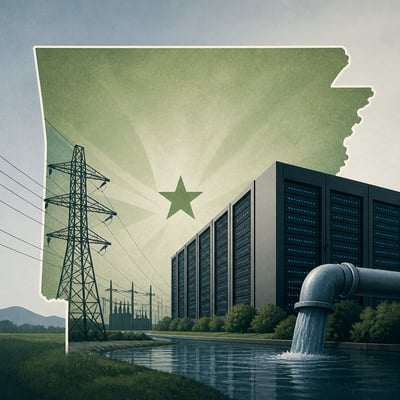
Pulaski County, Arkansas, is debating two large planned data centers: a roughly $1 billion Google facility near the Port of Little Rock and a larger AVAIO Digital project near Wrightsville. Residents and some local officials are seeking stronger rules or a moratorium, citing limited public input, high projected electricity and water demand, environmental risks, noise, and possible effects on utility rates. Project supporters and utilities say the developments will create jobs and tax revenue while operators will cover dedicated infrastructure costs and the water system can absorb the demand, leaving key questions focused on transparency, enforceable protections, and final project requirements.
First Article: 05/10/26
Latest Article: 07/01/26
History
The story is now framed more explicitly around Pulaski County's push for a moratorium or stronger local controls, alongside new legal uncertainty over how much authority local governments actually have. The public-disclosure dispute also became more central, while the utility-cost debate was sharpened by more specific statements about water and power impacts.
The story has sharpened from a general local zoning and moratorium fight into a more concrete dispute over two named hyperscale projects, their scale, and the transparency of the approval process. The new version adds stronger claims about utility impacts, public skepticism of closed-door planning, and the fact that Little Rock has already adopted some regulations while county action remains under consideration.
- Google and AVAIO project values are now estimated at roughly $1 billion and $6 billion.
- Combined power demand is estimated at more than 250 megawatts.
- Each project could use up to 4 million gallons of water per day.
- Residents object to invite-only meetings and nondisclosure agreements.
- Little Rock has adopted modest data center regulations.
The story has shifted from general project-and-rule development to a more concrete local regulatory fight, with Little Rock and Pulaski County now openly considering tiered rules and possible pauses on data center growth. The Port of Little Rock project has also become more legally and environmentally defined, with water, wastewater, and wetland issues emerging as central permitting constraints.
- Little Rock has proposed tiered data center rules.
- Pulaski County officials are discussing moratoriums or pauses.
- Wetland mitigation requirements affect the Port of Little Rock project.
- Water discharge and cooling limits are central to permitting.
- Utility rate effects are now part of the debate.
The story has shifted from general local pushback and proposed rules to concrete implementation, with Little Rock and Fayetteville now putting formal data center regulations into place. The current focus is more clearly on active project pipelines in West Memphis and central Arkansas, and on how utilities will handle power, water, and infrastructure costs.
- Google's West Memphis campus now anchors the announced investment wave.
- AVAIO's central Arkansas projects are highlighted as a major current driver.
- Little Rock has formal draft regulations on setbacks, cooling, wastewater, and acoustics.
- Fayetteville has adopted a conditional-use framework for data centers.
- Entergy and officials are now discussing infrastructure cost allocation and load flexibility.
The story has broadened from largely Little Rock-centered rulemaking into a wider multi-city regulatory push, with Fayetteville now actively tightening review standards and Broken Arrow weighing a temporary moratorium. The framing also shifts toward environmental and infrastructure scrutiny beyond water alone, especially noise, wetlands, wastewater, and power-system impacts.
The story has moved from a mostly Little Rock-centered regulatory response to a broader, more operationally specific crackdown on hyperscale data centers, with adopted rules now in force and more local permitting fights emerging. New projects and jurisdictions—especially Google and AVAIO-linked cases in Pulaski County, West Memphis, and Springdale-style disputes—make the issue feel wider and more contested than before.
- Little Rock adopted tiered data center regulations.
- Rules now restrict some groundwater or drinking-water cooling methods.
- Permitting fights are active at county, city, and state levels.
- Springdale-style permitting battles add a new contested geography.
- AVAIO is newly prominent in Pulaski County debates.
Little Rock has crossed from debating possible data center rules to actively adopting them, making the story primarily about regulation rather than just proposed development. The current update also sharpens the utility and environmental stakes, while confirming that broader Arkansas buildout remains active.
- Little Rock moved from proposing to adopting data center regulations.
- The June 2 Little Rock vote became the key regulatory moment.
- The ordinance now covers siting, setbacks, cooling, noise, and water use.
- Opposition is pushing moratoriums and disclosure of tax and utility terms.
- West Memphis and Pulaski County remain active development areas.
The story has broadened from a mostly Arkansas-local regulatory fight into a more fragmented, multi-jurisdiction buildout that now includes Springdale’s Pennsylvania project and a clearer focus on permitting sequencing. The Arkansas debate is also more concretely tied to specific regulators and utilities, with Little Rock’s rulemaking and the Port of Little Rock project now the central flashpoints.
- Springdale project has cleared conditional-use approval but still needs further permits.
- Frank Scott Jr. is now explicitly tied to proposed Little Rock data center rules.
- Allegheny DC Property Co. and Springdale Borough are new actors in the story.
- The Port of Little Rock campus is now the principal Arkansas regulatory flashpoint.
- The story now includes a Pennsylvania siting process alongside Arkansas projects.
The story has narrowed from a broad statewide data-center buildout to a more specific focus on regulatory tightening in Little Rock and Pulaski County, especially around water, noise, zoning, and transparency. The current version also adds clearer emphasis on who pays infrastructure costs and on environmental/permitting constraints as projects advance.
The story has broadened from a mostly Google-led Arkansas data center buildout into a wider local policy and permitting fight, with AVAIO joining as a major rival and cities/counties drafting tighter rules on siting, noise, water, and mitigation. The center of gravity has shifted toward implementation and regulation rather than just project announcements.
- AVAIO emerges as a major co-leading developer in Arkansas.
- Little Rock and Pulaski County are drafting tighter siting rules.
- Wetlands mitigation credits are now tied to specific projects.
- Officials are proposing limits on groundwater cooling and wastewater discharge.
- Calls for moratoriums and hearings show increased local pushback.
The story is now framed less as a set of named projects and more as a broader statewide infrastructure and policy test, with Arkansas officials and utilities actively working through power, water, siting, and incentive constraints. The updated version also sharpens the emphasis on unresolved community and cost-allocation issues rather than just project momentum.
The story has shifted from a broad proposal wave to a more operationally grounded buildout, with officials and utilities now openly dealing with grid costs, substation needs, water demand, and permitting. Arkansas also appears to be refining policy to fit large fiber-connected campuses, signaling more concrete sector support.
The story shifts from general Arkansas data center investment to a more specific picture of the bottlenecks governing whether projects proceed: power infrastructure, water supply, and tax treatment. The current version also broadens the set of active locations and emphasizes local reassurance efforts as political sensitivity remains high.
Arkansas is seeing a concentrated wave of data center investment led by Google, AVAIO Digital Partners, and Serverfarm, with major projects in West Memphis, Little Rock, Conway, and Clarksville. The developments are shaping state economic policy, utility planning, and local land use as officials address power, water, and community-impact questions. Much of the current focus is on how these large facilities will be powered, taxed, and integrated into surrounding communities.