History
07/27/20260 new articles
The story now places stronger emphasis on local political control and project timing, with the Bonner proposal specifically identified as withdrawn after a large petition campaign. It also broadens the comparison set to Missouri, while the core dispute over who pays for infrastructure costs remains unchanged.
07/25/20260 new articles
The story has sharpened from general local resistance into a more explicit fight over how Montana data centers will pay for power and infrastructure. The Broadview/Quantica proposal is now framed as the central legal and regulatory battleground, alongside new county moratorium and ballot-approval actions.
- Bonner project was withdrawn after public opposition.
- Yellowstone County is suing over the Broadview ballot initiative.
- Quantica cites a roughly 5,000-acre Broadview campus.
- Quantica has sought up to 7,235 megawatts in interconnection applications.
- Montana’s Ratepayer Protection Pledge targets developer-paid energy upgrades.
07/24/202620 new articles
The story has shifted from mostly county-level scrutiny and interim zoning toward more concrete regulatory action: Missoula County has now imposed a one-year moratorium on new or expanded data centers. At the same time, the issue has broadened into stronger voter-approval fights and cost-allocation pressure as large projects and utility impacts come into sharper focus.
- Missoula County approved a temporary one-year moratorium on new or expanded data centers.
- Residents in Yellowstone County and Butte-Silver Bow are pursuing voter-approval requirements.
- New legal uncertainty surrounds citizen initiatives versus county land-use authority.
- Quantica's Broadview campus is intensifying scrutiny of power and interconnection needs.
- Gov. Greg Gianforte signed a Ratepayer Protection Pledge on cost responsibility.
06/28/20260 new articles
No material change is visible between the two versions; the story’s framing, actors, and core regulatory conflict remain the same.
06/28/20260 new articles
No material change is present between the previous and current versions; the story remains a stable account of Montana’s tightening scrutiny of proposed data centers.
06/28/20265 new articles
The story broadened from a single Missoula County permitting fight into a wider Montana-wide political and regulatory response to data centers. The Bonner proposal is still central, but it is now one example within a larger push for interim zoning, ballot limits, and moratoriums.
- Montana Democrats added a data-center moratorium plank.
- Montana Republicans endorsed local control and resource limits.
- Butte-Silver Bow and Yellowstone counties launched voter-approval ballot efforts.
- Missoula County is considering interim zoning measures.
- NorthWestern Energy became a named reference point for power concerns.
06/14/2026Topic Formed
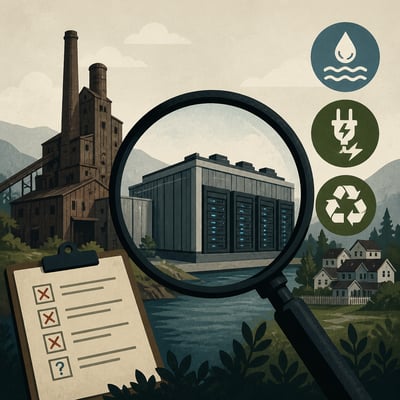
Missoula County is reviewing Krambu’s proposal to convert part of the former Bonner mill site into a data center, and the project has drawn scrutiny over water use, electricity demand, and compatibility with nearby residential areas. The application has faced repeated incompleteness findings, delaying a public hearing and keeping approval unresolved. County rules require special exception review, industrial zoning compliance, e-waste recycling plans, and new renewable power sources, making the proposal a test case for how the county will regulate data centers.

 Climate
 Privacy
 Bob Dylan
 Drones
 Data Centers
 AI Governance
 2026 Maine Senate Race