History
07/23/20260 new articles
The story now centers more narrowly on concrete nuclear supply paths for data centers, especially the Duane Arnold restart and existing-plant deals, rather than the broader mix of nuclear possibilities. It also more clearly frames new small modular reactor concepts as longer-dated and less immediate than restarts and upgrades.
07/22/20261 new articles
The story has broadened from a few nuclear-backed data center examples into a wider industry trend involving major tech firms, utilities, and government agencies. It now emphasizes that nuclear deals are moving into more concrete planning, while also highlighting major execution and grid risks.
- Google and Central Iowa Power Cooperative signed a 25-year commitment for Duane Arnold.
- Riot and Terrestrial Energy are considering up to 4 GW of nuclear capacity.
- Microsoft, Meta, Amazon, and OpenAI are now part of the story.
- PJM capacity costs are cited at $16 billion.
- Riot faces a patent lawsuit over immersion cooling technology.
06/29/20260 new articles
The story has become more concrete around two nuclear-linked data center pathways: Riot’s exploratory agreement with Terrestrial Energy and the Duane Arnold restart tied to Google demand. That shifts the narrative from general nuclear-backed power sourcing to identifiable projects with clearer counterparts and timelines.
- Riot Platforms signed an MOU with Terrestrial Energy.
- The plan involves IMSR reactors for data centers.
- Duane Arnold is planned to restart by end of 2028.
- The restart is tied to Google-linked data center demand.
- NextEra Energy and the U.S. Department of Energy are newly identified actors.
06/24/20263 new articles
The story has broadened from Riot's early-stage nuclear data center plan into a wider industry trend: major AI and cloud operators are now actively pursuing nuclear-backed power deals to secure capacity. That shifts the focus from one company's strategy to power access as a systemic constraint on AI infrastructure growth.
- Google, Microsoft, and OpenAI now appear as active power-seeking actors.
- The U.S. Department of Energy is now part of the story.
- Projects are extending into 2028 and the early 2030s.
- Local opposition and cooling disputes are now cited as operating risks.
05/30/20260 new articles
The story is now more explicitly centered on Riot’s nuclear-backed AI data center strategy, with the Terrestrial Energy partnership reframed around IMSR-powered baseload electricity. The emphasis has also narrowed further onto power scarcity as the core constraint, while execution remains early and contingent on financing and approvals.
05/23/2026Topic Formed
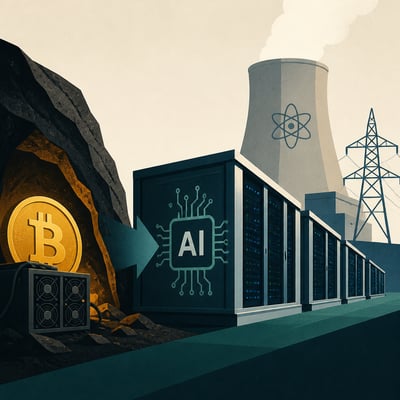
Riot Platforms is being reframed as a digital infrastructure company rather than only a Bitcoin miner, with new emphasis on AI and high-performance computing data centers. Recent developments include modular expansion at Corsicana, customer-driven capacity growth, and an MoU with Terrestrial Energy to explore nuclear-powered power supply. The main constraint across the material is access to reliable, large-scale electricity, which makes execution, financing, and regulatory progress central to the story.

 Climate
 Privacy
 Bob Dylan
 Drones
 Data Centers
 AI Governance
 2026 Maine Senate Race