
 Climate
 Privacy
 Bob Dylan
 Drones
 Data Centers
 AI Governance
 2026 Maine Senate Race
Florida Tightens Data Center Siting Rules
Coverage from The Invading Sea, WINK News, and others
00/00/0000
Articles
59
Active Days
81
The Topic
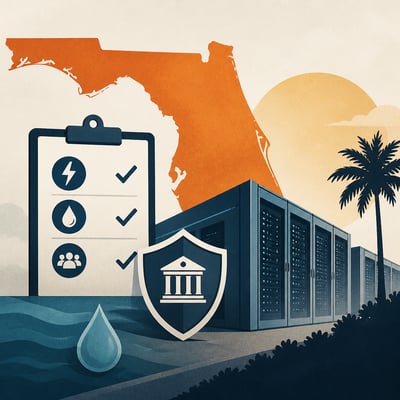
Florida is tightening rules for large data centers as communities and state officials debate their electricity demand, water use, economic benefits, and local impacts. Senate Bill 484 requires large-load customers to bear their own utility costs, preserves local planning authority, and adds restrictions on water permits, while transparency provisions remain contested. The debate is shaping whether projects such as Fort Meade, DeSoto County, and Project Tango proceed and under what conditions.
First Article: 05/07/26
Latest Article: 07/26/26
History
The story now centers more explicitly on SB 484 taking effect and shifting from debate over oversight to actual operating rules for large-load data centers, especially around cost allocation and water permits. It also tightens the framing around confidentiality, with transparency still contested rather than simply granted by the law.
Florida’s data center story has expanded from utility-cost fairness into a broader regulatory push covering disclosure and water permitting. The newest development is that approval and siting debates are now actively playing out across multiple counties, with several projects facing sharper local scrutiny.
- SB 484 permits some project information to remain confidential for up to 12 months.
- Water-permitting requirements begin July 1, 2026 for facilities above 50 megawatts.
- Fort Meade project could use up to 50,000 gallons of water daily.
- DeSoto, Palm Beach, St. Lucie, and Tallahassee projects face varied local responses.
- Local actions now include withdrawal, moratoria, and permanent bans.
The story now emphasizes implementation: Florida is moving from adopting SB 484 to having regulators set the actual tariff and service rules for large data centers. It also adds a clearer split between restricting public cost exposure and preserving tax incentives for qualifying projects.
The story has moved from a general report of Florida tightening data-center rules to a more settled account of SB 484 as the operative statewide framework. The main new wrinkle is that the law now also appears to constrain nondisclosure practices and preserve incentives, showing a mix of regulation and continued attraction policy.
The story shifts from a general implementation dispute over SB 484 to a more concrete local-policy response, with some counties now moving to bans or moratoriums on large data centers. That makes the issue less just about utility cost allocation and more about immediate siting restrictions and local resistance.
The story has moved from a broad report on Florida’s new data center restrictions to a more concrete implementation phase, with SB 484 now framed as active law and compliance fights already emerging. The biggest new wrinkle is that tariff design and regulatory enforcement are becoming the battleground, not just the legislation itself.
The story has broadened from a Florida-only regulatory framework into a wider cost-allocation and resilience narrative. The biggest new element is that Florida’s data-center rules are now being discussed alongside grid-upgrade risks, hurricane resilience, and a similar subsidy dispute in PJM.
- Resilience risks from hurricanes and weak infrastructure are now part of the Florida data-center debate.
- The story now references a related transmission-cost dispute in PJM.
- Grid upgrades and ratepayer protection are now explicit parts of the policy debate.
Florida’s SB 484 story has moved from a pending regulatory push to an enacted framework now set to take effect July 1. The latest version also sharpens the focus on implementation uncertainty, especially around rate impacts and how aggressively agencies and local governments will apply the new rules.
The core policy story is unchanged, but the framing has sharpened: SB 484 is now described more explicitly as a ratepayer-protection measure, with stronger emphasis on shifting not just power and infrastructure costs but also permitting burdens onto operators. The update also adds more implementation detail around water regulation and a slightly broader set of state actors involved.
The story has shifted from a specific Florida hyperscale-data-center law to a broader statewide framework governing large data centers and other large-load customers, with more emphasis on implementation and the regulatory machinery behind it. The current version also adds clearer context that AI-driven demand growth is the main force pushing the policy.
The core Florida data-center framework remains the same, but the story is now framed more explicitly as an active statewide response to AI-driven load growth and utility pressure. The current version also adds a clearer operational threshold, with 50 MW emerging as the key line defining covered large-load customers.
The story is now framed more explicitly as a statewide operating framework for hyperscale data centers, with the law moving from a ratepayer-cost issue into active implementation through utility, water, and siting rules. Coverage also tightens around the Fort Meade proposal as the key example and introduces limited out-of-state comparison points.
Florida has enacted SB 484 to require large data centers to pay their full electricity service costs rather than shifting infrastructure expenses to households and small businesses. The law also gives water managers authority to deny permits that would harm local supplies, while preserving local siting power and allowing temporary nondisclosure agreements that may limit public visibility of projects. Reporting around the law highlights growing concern over grid impacts, water demand, and where these facilities are being placed.