
 Climate
 Privacy
 Bob Dylan
 Drones
 Data Centers
 AI Governance
 2026 Maine Senate Race
Google Pairs Texas Data Centers With Power
Coverage from Axios, FOX 7 Austin, and others
Articles
9
Active Days
70
The Topic
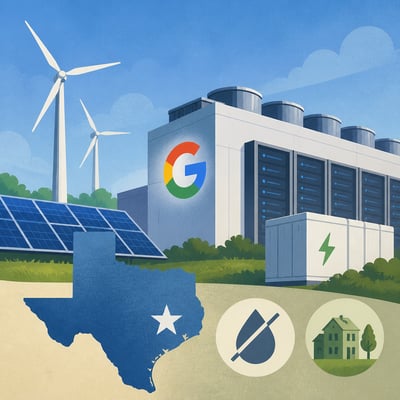
Google is expanding data center capacity in Texas while testing a power-first model that develops computing facilities alongside dedicated wind, solar, battery storage, and supplemental gas generation. The company is also signing large solar power agreements, funding Texas water projects, and promoting air-cooling or closed-loop systems to address resource concerns. These efforts could shorten power-supply timelines for new facilities, but they also raise questions about grid impacts, community acceptance, water stewardship, and whether planned clean-energy capacity will match rising demand.
First Article: 05/12/26
Latest Article: 07/20/26
Summary
- Google and Intersect are developing a Texas data center alongside more than 1 GW of wind, solar, and battery capacity at the Meitner Energy Center.
- Google is using co-located power projects and large solar purchases to secure electricity as transmission upgrades and grid interconnection can take years.
- The Steel River project in Arkansas will supply Google with 1.6 GW of solar capacity and 1.9 GWh of battery storage, with the first phases targeted for 2029.
- Google launched a $10 million Texas Water Impact Fund for communities where it plans data centers, supporting infrastructure upgrades, aquifer recharge, wetlands restoration, and related projects.
- Google says selected Texas facilities will use advanced air-cooling or closed-loop water systems, while its broader infrastructure expansion has driven record electricity and water consumption.
- The projects are intended to support reliability and reduce local grid dependence, but some Texas communities remain concerned about water use, regulation, traffic, and development impacts.
History
The story now emphasizes that Google is pairing Texas data center expansion with longer-term solar contracting and power infrastructure to speed electricity access, while the risk framing has broadened to include grid, water, and local infrastructure pressures. It also sharpens the policy and community lens around whether clean-energy supply will keep pace with rapidly rising demand.
The story broadened from a Texas-specific data center buildout into a larger Google power procurement strategy spanning multiple projects and states. It now includes specific contracted renewable supplies, a second Texas co-location project, and updated scale data showing the infrastructure push is materially larger than before.
Featured
Timeline: 70 Days
Hover over any logo to see coverage summary, click for full article.