
 Climate
 Privacy
 Bob Dylan
 Drones
 Data Centers
 AI Governance
 2026 Maine Senate Race
Communities Push Back on Data Centers
Coverage from The Conversation, Houston Public Media, and others
00/00/0000
Articles
44
Active Days
76
The Topic
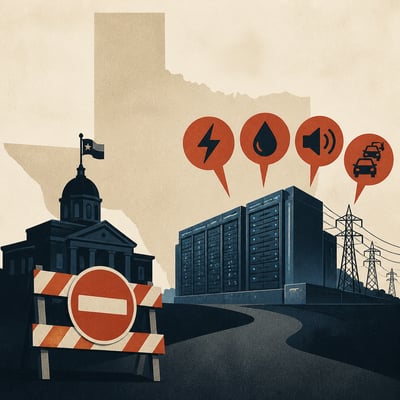
Local governments and residents are pushing to pause, restrict, or more closely review data center projects as concerns grow over noise, water use, electricity costs, grid reliability, and pressure on public infrastructure. Texas is the clearest focal point, with counties and cities pursuing moratoriums, stricter standards, and state intervention while Gov. Greg Abbott calls for developers to bear more of the costs. The disputes are increasingly shaping permitting decisions, political campaigns, and the balance of authority between local and state governments.
First Article: 05/12/26
Latest Article: 07/26/26
History
The story has shifted from a focus on specific Texas local actions and grid-demand forecasts to a broader dispute over who should pay for data center impacts and how local-state authority will be enforced. The new version also elevates the political stakes by noting that these disputes are now influencing permitting and campaigns.
The story now places greater weight on statewide intervention and operational impacts, with Abbott and regulators pushing costs onto developers while ERCOT’s demand forecast makes future power strain more urgent. It also adds a concrete complaint case near an operating facility, showing the issue is no longer just about proposed projects.
- Abbott directed state agencies to make facilities pay electric infrastructure and power costs.
- ERCOT projects data centers will drive a 71% increase in Texas energy demand by 2031.
- Residents report persistent noise and vibration complaints near Giga Energy’s Brazoria County facility.
- Local action is constrained by limited zoning authority and state intervention.
- Lockhart’s strict standards were shaped by litigation concerns.
The story has broadened from a largely Texas-centered policy fight into a wider U.S. pattern of local pushback, with new details showing some projects being challenged, withdrawn, or mitigated. It also adds a more explicit sense that development is slowing through delays and restrictions rather than just facing proposed limits.
- Developers are adding mitigation measures, including sound walls.
- Some local decisions are being challenged in court.
- The story now includes withdrawals of some projects.
- Hill County’s pause comes amid plans for up to eight facilities.
- Texas polling shows stronger opposition among rural residents.
The story has sharpened from a general local backlash into a more specific Texas policy fight, with new state-level pressure and stronger evidence of broad public opposition. Abbott’s push to shift infrastructure costs to developers now sits alongside poll and ERCOT data that make the conflict appear more urgent and politically consequential.
- Texas Gov. Greg Abbott asked regulators to shift infrastructure costs to data centers.
- A University of Texas poll found 56% of Texans oppose local data centers.
- ERCOT projects a 71% rise in Texas electricity demand by 2031.
- Brazoria County adopted formal data center requirements.
- Current framing centers Texas-specific state and local conflict.
The story has broadened from a mainly Hill County moratorium dispute into a wider Texas policy response focused on making developers pay more of the infrastructure and utility costs they create. State action from Greg Abbott and ERCOT, plus stricter local standards in places like Brazoria County and Lockhart, show the fight shifting from pause orders to more detailed regulation.
- Greg Abbott directed regulators to make data centers bear electric infrastructure costs.
- Brazoria County sought independent impact assessments and land-protection measures.
- Lockhart opted for strict standards over an outright ban.
- Noise and vibration emerged as a more visible local issue.
- Public Utility Commission of Texas and ERCOT were newly named in the policy response.
The story broadened from a single Hill County moratorium dispute into a wider Texas county-level push to slow data center growth, with state lawmakers and officials now entering the picture. The legal and regulatory fight remains central, but the emphasis is increasingly on how counties statewide may test the limits of their authority.
- Other Texas counties are considering or passing related data center limits.
- Texas lawmakers and state officials now figure in the dispute.
- The story now centers on county authority versus state rulemaking.
- Temporary moratoriums and legal review are the main response tools.
The story has sharpened from a broad Texas local-government trend into a more concrete Hill County legal fight, with the moratorium now extended to related power plant construction and an active federal challenge underway. The emphasis is less on general resistance and more on litigation risk, project-specific impacts, and the uncertain legality of county action.
- Moratorium expanded to related power plant construction.
- RCM Hill, LLC filed a federal lawsuit against the moratorium.
- Provident Data Centers' 300-acre Hillsboro project is now central.
- A separate 1,235-megawatt project is also implicated.
- County officials cite study needs, but authority is disputed.
Texas counties and cities are increasingly using moratoriums, resolutions, and review requirements to slow or condition data center development. The main concerns are electricity demand, water use, noise, infrastructure strain, and the limited authority local governments have under Texas law. State officials are also entering the debate, raising the likelihood of broader regulation and legal conflict.