
 Climate
 Privacy
 Bob Dylan
 Drones
 Data Centers
 AI Governance
 2026 Maine Senate Race
Texas Data Centers Face Water Strain
Coverage from Houston Public Media, Sierra Club, and others
00/00/0000
Articles
95
Active Days
83
The Topic
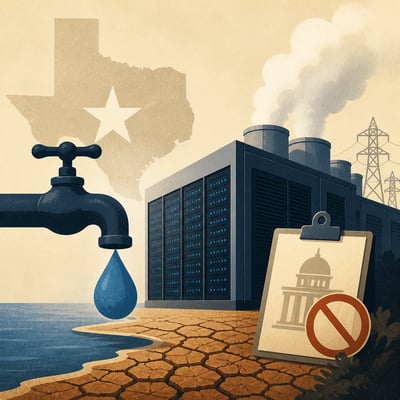
Texas is preparing for continued data center expansion tied to artificial intelligence and cloud computing while facing limited information about facilities’ water and power requirements. Estimates indicate that data center water demand could rise substantially, but the range remains uncertain because cooling systems, electricity sources, and project plans vary. Lawmakers, local governments, researchers, and residents are debating disclosure rules, conservation measures, infrastructure costs, and who should control project approvals.
First Article: 05/07/26
Latest Article: 07/28/26
History
The story now centers more clearly on active state-level policy consideration: Texas lawmakers and Governor Abbott are weighing disclosure and conservation measures, while the latest framing adds uncertainty around facility cooling systems and some projects’ nondisclosure agreements. The core water-risk narrative remains the same, but it is now more explicitly tied to approval authority, cooling choices, and implementation constraints.
The story has become more concrete and immediate: instead of a broad debate over projected water and power strain, it now centers on a specific $10 billion proposed campus and the practical conflicts it would trigger over annexation, wastewater, and who pays for infrastructure. The framing also broadens beyond water to include electricity, backup power, and local permitting authority.
- Nearly $10 billion Infrakey campus proposed near Ross and Lacy Lakeview.
- Texas has about 300 operating data centers and hundreds more planned.
- Texas GOP delegates are considering data center local-control and fee measures.
- Power planners now face timing and cost questions for generation and backup power.
- California example now cites 1–5 million gallons daily and slower water sourcing.
The story has shifted from a broad Texas data-center water dispute to a more concrete policy fight over disclosure, cooling standards, and local approval authority, with Governor Abbott and lawmakers now directly considering specific reporting and supply rules. The updated version also adds a clearer power-demand estimate and centers the Infrakey/Ross-Lacy Lakeview controversy as the local example of these tensions.
- Greg Abbott is proposing annual water-use reporting and closed-loop cooling.
- Some Texas data center projects are covered by non-disclosure agreements.
- Texas facilities currently require about 9.6 gigawatts of power.
- Lawmakers are considering non-potable supplies and other water-demand limits.
- The Infrakey dispute now includes wastewater, roads, sewers, and environmental risks.
The story has become more quantified and policy-specific: new estimates sharply raise the perceived scale of Texas data center water and power demand, while state leaders are moving toward formal reporting and cooling requirements. It also broadens from local siting disputes to a wider debate over statewide water planning, grid readiness, and infrastructure timing.
- UT Austin estimates Texas data centers could reach 3%–9% of statewide water use by 2040.
- Current Texas data centers are estimated to use about 25 billion gallons of water annually.
- Potential Texas data center water demand could reach 161 billion gallons per year by 2030.
- Greg Abbott is proposing annual water-use reporting and closed-loop cooling.
- California examples highlight water infrastructure lagging behind data center construction.
The story has become more concrete and locally grounded: instead of a broad Texas-wide infrastructure dispute, it now centers on specific projects and communities where annexation, zoning, and tax treatment are being actively contested. State oversight has also moved from general concern to process revisions by ERCOT and lawmakers as reporting gaps persist.
- Specific projects in Ross and Lacy Lakeview have become dispute flashpoints.
- ERCOT and lawmakers are revising review and disclosure processes.
- Some communities have imposed bans, moratoriums, or zoning restrictions.
- Tax exemptions and utility cost recovery are now central policy issues.
- Texas Water Development Board has flagged reporting gaps.
The story has broadened from a planning debate into a more explicit state-level policy fight over who controls approvals and pays for the infrastructure needed to support Texas’s accelerating data center buildout. The newest framing also sharpens the scale of the problem, tying it to statewide water and electricity planning through 2040.
- UT Austin now estimates data centers could use 3% to 9% of Texas water by 2040.
- The issue is now framed as a state-level policy debate over approvals and infrastructure costs.
- Developers are promoting behind-the-meter power and reclaimed wastewater as mitigation.
- Lawmakers say many facilities still do not disclose enough water-use information.
The story has broadened from a Texas planning dispute into a more explicit fight over who controls data center siting and disclosure rules, with local governments and industry now playing more visible roles. The core concerns remain water and grid strain, but the framing now emphasizes local permitting authority, transparency, and sustained political pressure.
The story has shifted from a broad Texas data-center infrastructure conflict to a more specific, active policy and planning response centered on water scarcity and grid management. The new emphasis is on ERCOT and state regulators revising rules now, while Republicans debate whether Texas should still prioritize AI growth or give counties more control.
- UT Austin estimates data centers could use 3% to 9% of Texas water by 2040.
- ERCOT is changing its large-load review process.
- State leaders want developers to pay for grid upgrades.
- Texas Republicans are split over county siting authority.
- Current reporting emphasizes active planning and regulation.
The story has broadened from a Texas water-and-grid strain narrative into a more explicit policy fight over cost allocation, self-supply, and local authority, with ERCOT and state officials now moving toward concrete rule changes. It also now reads as part of a wider U.S. pattern, not just a Texas-specific problem.
- Proposed demand has reached hundreds of gigawatts.
- Officials are considering rules on self-generation and cost allocation.
- Data centers may face new electricity and water reporting requirements.
- Counties are seeking zoning and moratorium authority.
- Similar disputes are emerging in North Carolina, PJM, California, and Oregon.
The story has shifted from a general Texas data-center scrutiny narrative to a more concrete policy and infrastructure fight. New reporting emphasizes the scale of the buildout pipeline and shows regulators and state actors actively changing review, siting, and cost-allocation rules.
- Hundreds of operating or planned Texas data centers are now part of the story.
- ERCOT is adjusting large-load interconnection review processes.
- New policy ideas include impact fees and limits on tax incentives.
- Industry groups are promoting closed-loop and reclaimed-water strategies.
The story has broadened from a Texas-centered water and permitting dispute into a wider governance fight over how fast data center buildout should proceed and who gets to approve it. New reporting also ties water planning more explicitly to grid planning and adds broader political fracture within Texas, including more prominent developer and national project references.
- Permit data show hyperscale projects spreading across many states and metro areas.
- Water planning and grid planning are now explicitly linked.
- Some Texas Republicans now favor pauses or guardrails on large projects.
- Major developers including OpenAI-linked projects, Google, Amazon, and QTS are newly named.
The story has broadened from a water-use and permitting issue into a more integrated Texas infrastructure debate that now explicitly includes grid capacity and local control. It also adds more visible stakeholder pressure from county officials, residents, ERCOT, and industry groups.
The story is still centered on Texas data centers' water burden, but it has shifted from forecasting to active policy friction. The newest framing emphasizes hearings, permit delays, moratorium ideas, and planning/transparency demands.
The story has shifted from a broad concern about Texas data center water use into a more explicit policy fight over whether the state should prioritize AI-driven growth or give local governments more power to slow projects. The current version also places greater emphasis on power-linked water use and active permitting disputes in Central Texas.
The story has shifted from a general water-stress debate to a more operational one centered on where data centers are being built and whether Texas can support them with enough water, power, and local permitting capacity. A new policy thread has also emerged around tax incentives and public costs.
The story is now framed more explicitly as a looming legislative and local-control fight, not just a water-risk warning. The new version also adds stronger political context: county and city permitting authority, rural Republican backlash, and industry messaging are now central to the dispute.
Texas is facing growing scrutiny over how rapidly expanding data centers will affect water supplies, local infrastructure, and state regulation. UT Austin research projects data centers could use 3% to 9% of statewide water by 2040, far above current levels, while lawmakers and local officials debate whether to impose guardrails or moratoriums. The issue now blends resource planning with political conflict, especially as the industry and its allies push back against backlash and promote economic benefits.