
 AI Governance
 Data Centers
 Drones
 Climate
 Privacy
 Bob Dylan

Drones: Featured Story
Coverage from Tech360, Interesting Engineering, and others
Drone Folds Through Gaps Half Its Width
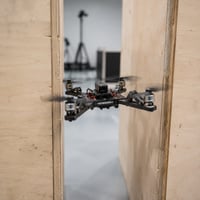
Researchers at the Norwegian University of Science and Technology and ETH Zurich developed a quadrotor whose spring-loaded arms fold on contact, narrowing its width by 55% without dedicated folding motors. Flight tests showed it could pass through gaps and a tube, including approaches angled up to 30 degrees, while adding little tracking error or power use in ordinary flight. The work is described in an arXiv preprint, and tests also revealed arm dislocations at steeper approach angles.
If you read one thing
A clear overview of how the arms fold on contact, what the flight demonstrations showed, and where the design struggled.
The evidence
Adds detail on the angled-approach trials, including the reported arm dislocations and recovery after difficult crossings.
The prototype demonstrated narrow-gap traversal and low added power use and tracking error in ordinary flight, but contact maneuvers were not always smooth and steep approaches could dislocate an arm. The evidence describes laboratory tests, not established performance in operational settings.
Contact with an opening folded the arms, reducing the prototype's width from 31.3 cm to 14.1 cm; tests included a 15-by-20-cm opening and a tube that kept the arms folded during transit.
In angled trials, traversal was reported as reliable up to 30 degrees, while arm dislocations occurred at steeper angles. The crossings could also involve substantial tilting and altitude loss before recovery.
Compared with a rigid counterpart in ordinary flight, the compliant design added about 2 mm of tracking error and less than 1% power use; folding required no dedicated motors.
The work is reported as an arXiv preprint, and the reported demonstrations do not establish how the prototype performs beyond the tested conditions.