
 Climate
 Privacy
 Bob Dylan
 Drones
 Data Centers
 AI Governance
 2026 Maine Senate Race
Agricultural Drone Adoption
The ongoing major issues seen in articles and topics over time.
The Drivers
2
Articles Related
26
The Big Picture
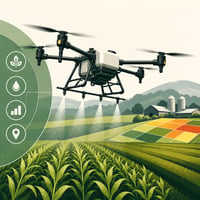
Farms, agribusinesses, and rural service providers are adopting drones for crop spraying, crop scouting, precision agriculture, biological pest control, livestock and wildlife detection, and field operations in difficult terrain or wet conditions. The issue includes equipment choices, farm-service business models, operator licensing, spray calibration, drift management, safety practices, and integration with broader agricultural workflows.
Agricultural drones can reduce labor needs, expand access to fields when ground equipment is impractical, improve input targeting, and create new service markets for rural operators. Their adoption will continue to generate regulatory, safety, economic, and technology developments as farms evaluate drones against conventional aerial applicators, ground sprayers, and precision-agriculture systems.
Categories
Agriculture & Land Management, Market, Companies & Supply Chain, Regulation, Safety & Airspace Integration, Autonomy, AI & Software
Keywords
aerial applicator license, Agras T50, agricultural drone safety, agricultural drones, agricultural spray drone ROI, American-made agricultural drones, autonomous cattle counts, beneficial insect release, biocontrol drones, calving detection, cattle counting drones, Central UAS Technologies, commercial applicator license, commodity inventory drones, crop scouting, crop spraying drones, DJI Agras, DJI Agras T100, DJI Agras T55, DJI Mavic 3 Enterprise agriculture, domestic agricultural drone manufacturing, drift reduction, drone spraying services, drone-in-a-box ranching, farm drone services, farm spray drone supply chain, feedlot inventory drones, feedyard mapping, forage biomass measurement, HeadCount Inventory, Hylio AgDrones, Hylio HYL-150 ARES, livestock detection, livestock inventory, precision agriculture, precision ranching, PrecisionVision 100X, PV100X Pro, spray calibration, spray drone breakeven, spray drone economics, variable-rate application, virtual fencing drones, wet-field spraying, wildlife detection
The Drivers
The Topics below, and their articles, all focus on, exemplify, or help to explain this theme.
Primary
- 99
Agricultural Spray Drones Expand
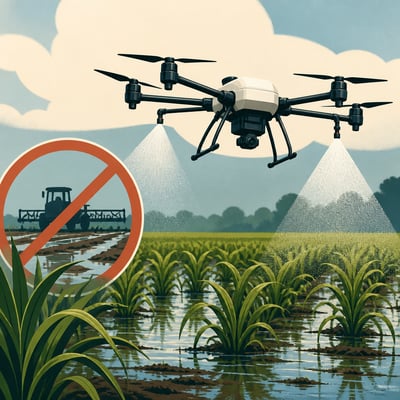
Agricultural spray drones are moving into broader commercial use for crop protection, spreading, and related farm tasks. DJI’s Agras T55 and T100 launches extend capacity, flight time, sensing, and orchard coverage, while U.S. custom applicators are operating multiple aircraft across large acreages. Adoption is strongest where drones can reach wet, steep, irregular, or tall-crop fields, but regulation, chemical labeling, insurance, weather, and operator safety continue to limit deployment.
Articles: 22
Last Updated: 07/28/2026
- 96
DJI Drones Count Cattle
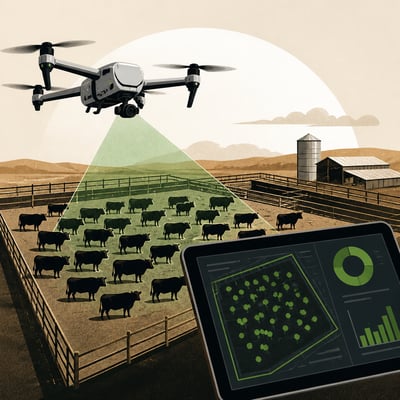
This topic centers on ranch and feedyard operators using DJI drones to count cattle, verify inventory, and track commodities more quickly than manual checks. HeadCount Inventory is the main operator in the material, pairing autonomous flights with human quality control and reporting tools for large livestock operations. A related strand connects drones with virtual fencing, remote monitoring, and other precision ranching tasks, showing drone use moving from occasional imaging toward routine operational support.
Articles: 4
Last Updated: 07/08/2026