
Last Update: 08/01/2026 at 1:34 PM EST

Agricultural Spray Drones Expand

Coverage from DroneDJ, No-Till Farmer, and others

Articles

21

Active Days

88

The Topic
Agricultural Spray Drones Expand topic image

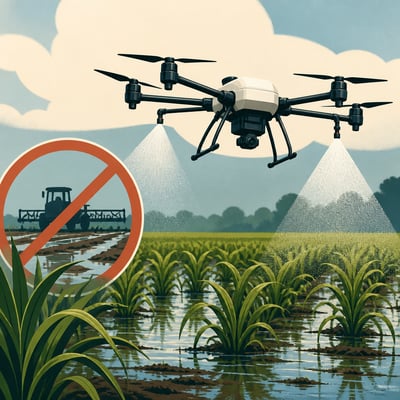
Agricultural spray drones are moving into broader commercial use for crop protection, spreading, and related farm tasks. DJI’s Agras T55 and T100 launches extend capacity, flight time, sensing, and orchard coverage, while U.S. custom applicators are operating multiple aircraft across large acreages. Adoption is strongest where drones can reach wet, steep, irregular, or tall-crop fields, but regulation, chemical labeling, insurance, weather, and operator safety continue to limit deployment.

First Article: 04/27/26

Latest Article: 07/23/26

Summary

  • DJI launched the Agras T55 and dual-battery T100 for spraying, spreading, lifting, and orchard work.
  • Illinois custom operators are using multiple DJI Agras T50s and EAVision J-150s to cover thousands of acres.
  • Spray drones are most useful where ground equipment faces wet soils, steep terrain, irregular boundaries, waterways, or tall crops.
  • Prescription maps and adjustable flight parameters can support more targeted applications, but performance depends heavily on wind, temperature, droplet size, height, and speed.
  • New platforms increasingly emphasize larger payloads, longer hover time, radar or LiDAR sensing, and improved obstacle avoidance.
  • FAA approvals and insurance remain important in the United States, while Europe faces inconsistent exemptions to restrictions on aerial pesticide dispersal.
  • The material presents drones primarily as complements to conventional sprayers rather than universal replacements.

History

07/23/2026

The story has broadened from spray drones mainly for crop protection to a wider commercial farm-tool category that also includes spreading and lifting, with more emphasis on larger-scale operations and precision features. The framing also tightens the main constraints around regulation, chemical labeling, insurance, weather, and operator safety, while adding Europe as a regulatory barrier zone.

07/22/2026

The story has broadened from a Midwestern custom-application niche into a larger commercial spray-drone market, driven by DJI’s new higher-capacity Agras models and wider competitive pressure. It now places more emphasis on operational and regulatory constraints that determine whether drones can scale beyond niche use.

Full History

Featured

Timeline: 88 Days

Apr 27May 11Jun 1Jun 15Jul 6Jul 20

Additional Articles

⭐⭐⭐⭐⭐

Commercial UAV News05-21-2026
HTS Ag president Adam Gittins explains why spray drone operators need training in calibration, droplet sizing, and Part 107 preparation for large-farm pesticide application.
Farm Progress06-12-2026
Illinois drone operators use EA Vision J-150 and DJI T-50 fleets with custom gooseneck trailers to scale fungicide and insecticide spraying and crop scouting.
Farm Progress / Andy Castillo06-29-2026
University of Missouri researchers evaluated DJI Agras T20 and T40 agricultural spray drones, estimating breakeven at about 1,000 acres annually over eight years.

⭐⭐⭐

The Batavian04-27-2026
Charles Augello of WNY Aerial AG uses drones for herbicide spraying in wet Genesee County, New York, to meet short crop treatment windows and avoid soil damage.
Growing Produce06-29-2026
CropLife profiles U.S. market agricultural spray drones from Agri Spray Drones, DJI, and others, emphasizing LiDAR or radar autonomy and higher payload capacity.
AgUpdate07-23-2026
Kansas wheat producers use combine yield maps and mapping and spray drones to target weed and pest areas, guided by precision agriculture practices.
Texas A&M Stories07-23-2026
Texas A&M Universitys Landscape Ecology and Drones Lab uses drones and hyperspectral sensing in Texas to forecast forage conditions and support invasive species control.
Agriculture / Curt Bennink07-01-2026
DJI Agriculture announced Agras T55 and Agras T100 dual-battery spraying drones, adding millimeter-wave obstacle detection and improved spraying performance.
WTHI / Audrey Geib07-16-2026
In Indiana, farmers adopt imaging and spray drones to manage crops by scouting diseases and applying fungicides during wet conditions that restrict ground equipment.
WTVG / Annie Giovannucci06-10-2026
Vertical Ag in Wauseon, Ohio scaled agricultural drone spraying after a 2023 start, using commercial licensing to expand acres during July and August.
Commercial UAV News07-22-2026
A Commercial UAV News webinar in 2024 and 2025 timeframe examined European agricultural drone adoption, emphasizing spraying, EU pesticide rules, and STS-03 framework expectations.
Farm Progress06-17-2026
Three Illinois drone business owners set $12 to $15 per-acre pricing for drone spraying and fungicide application while managing chemical sourcing and compliance paperwork.
Farm Progress06-18-2026
Illinois ag drone business owners discussed drone spraying expansion and equipment planning while citing battery life and charging infrastructure limits.
Farm Progress07-13-2026
Lance Maschino built a custom truck-mounted rig in North Vernon, Indiana, to power and operate an EAVision J150 agricultural spray drone.
Barchart / Charles Barkley07-03-2026
In the 2020s, VECTORAGR expanded agricultural drone spraying in the United States through partners and research as growers address labor shortages and seek precision efficiency.
Brownfield Ag News06-25-2026
WinField United marketing manager Joe Vaillancourt discusses adjuvants and drift-controlled droplet targeting for drone crop spraying at a workshop in Story City, Iowa.
Brownfield Ag News07-10-2026
Justin Owens of Nationwide Insurance said agricultural drone use requires farm policy review because many policies exclude drone liability and classify drones as aircraft.
Brownfield Ag News / Jared White07-15-2026
Illinois and Wisconsin farmers use drones to apply fungicides in wet-season corn fields as tar spot disease pressure increases.