
 Climate
 Privacy
 Bob Dylan
 Drones
 Data Centers
 AI Governance
 2026 Maine Senate Race
New York Airport Drone Encounters
Coverage from The New York Times, Reuters, and others
00/00/0000
Articles
56
Active Days
90
The Topic
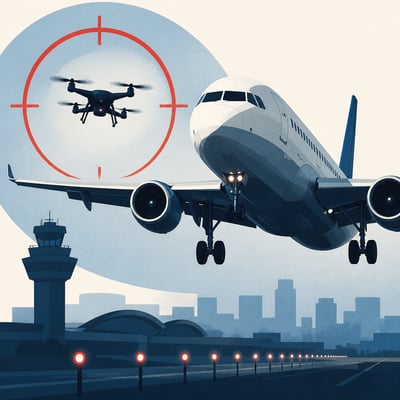
Passenger aircraft reported drone encounters while approaching Newark and JFK airports in late June 2026. All affected flights landed safely, but the reports have renewed attention on unauthorized drone operations near controlled airspace, airport detection measures, and the difficulty of confirming alleged collisions when inspections find no aircraft damage or corresponding drone evidence.
First Article: 04/29/26
Latest Article: 07/27/26
History
The story has narrowed from a broader pattern of repeated airport drone encounters to two specific late-June 2026 incidents in the New York area, one near Newark and one near JFK. The key update is the addition of a Newark near miss, plus renewed emphasis on how hard it is to verify alleged drone strikes when inspections find no corroborating damage or evidence.
The story has broadened from recurring drone sightings near a few airport approach paths to a more clearly documented, multi-airport safety issue, with new FAA data showing a rising volume of reported close encounters in 2026. The framing also shifted toward post-incident verification, with many reports now weakened by inspections, radar reviews, or lack of corroboration.
- JFK emerges as a major site for reported drone incidents.
- FAA quarterly data show a sharp increase in close encounters in 2026.
- Some reports lacked corroboration after radar and inspection review.
- Remote ID and LAANC are now explicitly part of the story.
- Most reported encounters ended with safe landings and no confirmed strike.
The story broadened from a single San Diego approach incident into a recurring multi-airport FAA enforcement issue, with Newark now joining San Diego as a major hotspot. The new reporting strengthens the case that this is a repeated airport-airspace problem, not an isolated close call.
- Drone sightings were reported near Newark Liberty International Airport.
- FAA investigations now span multiple airport incidents.
- GoJet Airlines is newly involved in reporting a Newark drone sighting.
- Reports mention frequent monthly airport-adjacent drone sightings.
- A small number of incidents reportedly required evasive action.
The story is largely unchanged, but the framing has sharpened: current coverage is even more explicit that the key issue is a possible drone encounter under active FAA review, not a confirmed strike. The emphasis has also shifted slightly toward compliance and detection limits rather than the incident itself.
The story is largely stable, but the framing has shifted slightly toward tighter regulatory language around Remote ID, authorization, and enforcement limits. The core incident remains the same: a reported drone close call over San Diego with safe landing and no damage.
The story is largely stable, but the latest version tightens the framing around a specific United flight and adds more explicit regulatory context. It also broadens the supporting references slightly with historical enforcement examples, though the core incident remains the same and unresolved.
The update slightly reframes the incident as a suspected drone encounter rather than a more definite strike/near-miss, while keeping the core facts unchanged: FAA review, no damage, and ongoing airspace enforcement concerns.
The story is slightly reframed from a reported drone close call to a still-unconfirmed possible strike or near-miss, with emphasis on the repeated nature of the reporting and ongoing FAA review. The core facts remain stable: no damage, safe landing, and no corroborated additional sightings.
The update mainly sharpens the framing of the incident: it now emphasizes verified safety outcomes and the broader enforcement problem of detecting unauthorized drones in controlled airspace. The story remains centered on the same single United flight, but the interpretation shifts from a possible strike to a near-miss with no damage confirmed.
The story is largely unchanged, but the current version more clearly centers the FAA’s role in using the incident to reinforce drone airspace restrictions. The framing also tightens around a single unresolved near-miss report rather than any broader pattern or additional evidence.
The story is largely stable, but the framing has sharpened slightly around an unverified suspected drone encounter and the operational challenge of confirming sightings in real time. The current version also adds the Boeing 737 crew as a more specific actor and emphasizes low-altitude reporting details.
The core story is largely unchanged, but the framing has tightened from an unresolved drone-sighting investigation to a more explicit compliance-and-verification problem in controlled airport airspace. The current version places more emphasis on unauthorized drone operations and the difficulty of confirming whether contact actually occurred.
Recent coverage repeatedly describes a reported drone encounter near San Diego International Airport involving United Airlines Flight 1980, with FAA investigation, safe landing, no aircraft damage, and continuing concern about illegal drone activity near airports.