
 Climate
 Privacy
 Bob Dylan
 Drones
 Data Centers
 AI Governance
 2026 Maine Senate Race
Amazon Expands Prime Air Deliveries
Coverage from The Conversation, Axios, and others
Articles
23
Active Days
80
The Topic
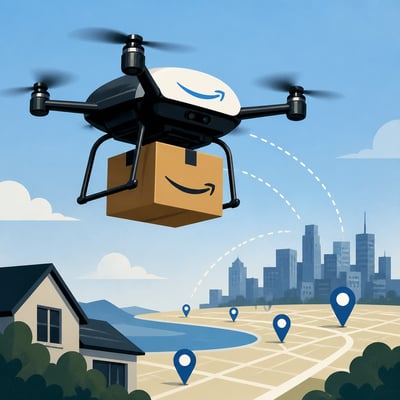
Amazon is expanding Prime Air, using autonomous MK30 drones to deliver packages weighing up to five pounds within roughly 7.5 to 8 miles of selected fulfillment centers in the United States and the United Kingdom. New services in places such as Baton Rouge, Cleveland, Omaha, and Darlington are being introduced under daylight, weather, airspace, and designated drop-off limits, while delivery vans continue to serve customers alongside drones. The expansion is also generating questions about noise, privacy, local control, and occasional failed deliveries, making community consultation and reliable drop-off procedures important to wider adoption.
First Article: 05/06/26
Latest Article: 07/24/26
Summary
- Prime Air is adding delivery locations in U.S. communities including Baton Rouge, Cleveland, Omaha, and the Detroit area, while operating in parts of the U.K.
- The MK30 generally carries packages weighing five pounds or less and serves customers within about a 7.5- to 8-mile radius of a fulfillment center.
- Flights are constrained by daylight, weather, temperature, airport restrictions, and designated drop-off areas.
- Amazon describes the drones as autonomous, with onboard sensors, cameras, and detect-and-avoid systems monitored by human personnel.
- Residents and local officials have raised concerns about drone noise, privacy, safety, and neighborhood effects.
- Local governments may have limited authority over flight paths because the FAA controls U.S. commercial airspace operations.
- Reported package drops near ponds and pools show that delivery-site selection and final drop-off reliability remain operational issues.
History
Amazon’s drone-delivery story has broadened beyond the prior U.S.-only rollout to include UK operations, while sharpening the operational limits and community issues around the MK30 system. The new version also places more emphasis on direct customer-property drop-offs, privacy concerns, and the role of local authorities versus FAA control.
The story has shifted from a general account of Prime Air constraints to a concrete U.S. expansion, with Amazon now adding new delivery markets and scaling operations from fulfillment centers. The core tension remains the same, but it is now more clearly about operational rollout in specific cities rather than just regulatory and neighborhood friction.
Featured
Timeline: 80 Days
Hover over any logo to see coverage summary, click for full article.