
 Climate
 Privacy
 Bob Dylan
 Drones
 Data Centers
 AI Governance
 2026 Maine Senate Race
Amazon Expands Prime Air Deliveries
Coverage from The Conversation, Axios, and others
00/00/0000
Articles
23
Active Days
80
The Topic
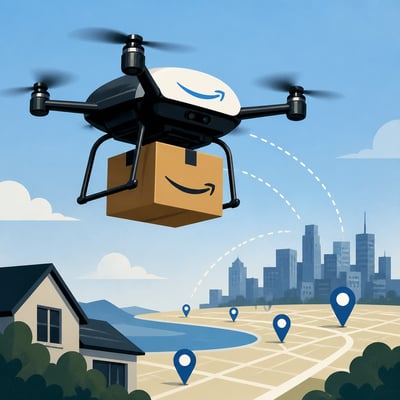
Amazon is expanding Prime Air, using autonomous MK30 drones to deliver packages weighing up to five pounds within roughly 7.5 to 8 miles of selected fulfillment centers in the United States and the United Kingdom. New services in places such as Baton Rouge, Cleveland, Omaha, and Darlington are being introduced under daylight, weather, airspace, and designated drop-off limits, while delivery vans continue to serve customers alongside drones. The expansion is also generating questions about noise, privacy, local control, and occasional failed deliveries, making community consultation and reliable drop-off procedures important to wider adoption.
First Article: 05/06/26
Latest Article: 07/24/26
History
Amazon’s drone-delivery story has broadened beyond the prior U.S.-only rollout to include UK operations, while sharpening the operational limits and community issues around the MK30 system. The new version also places more emphasis on direct customer-property drop-offs, privacy concerns, and the role of local authorities versus FAA control.
The story has shifted from a general account of Prime Air constraints to a concrete U.S. expansion, with Amazon now adding new delivery markets and scaling operations from fulfillment centers. The core tension remains the same, but it is now more clearly about operational rollout in specific cities rather than just regulatory and neighborhood friction.
- Prime Air is adding Baton Rouge, Cleveland, and Omaha as new delivery markets.
- Amazon drones are launched from fulfillment centers for local deliveries.
- Amazon continues using delivery vans alongside drone service.
- Service is limited by airport airspace and suitable drop-off area availability.
- Routine U.K. operations are now targeted for 2027.
The story shifts from a general rollout-and-complaints narrative to a more specific operational challenge centered on MK30 drone use, delivery errors, and whether repeated site use can be sustained under local planning rules. The biggest new emphasis is that community acceptance and land-use approvals, not just flight permissions, are now the main bottlenecks.
The story now places more weight on local operational friction, especially recurring noise complaints and the limits of municipal control, rather than mainly on safety history and rollout constraints. It also broadens slightly into additional active and preview markets in the U.S. while keeping UK planning approval as a key bottleneck.
The story now includes a broader, more operational rollout picture: Amazon Prime Air is not just expanding service, but doing so amid explicit safety history, local planning hurdles, and neighborhood opposition. The UK side is also more clearly framed as a land-use/permission problem, not just an aviation-approval issue.
The story shifts from a general expansion narrative to a more concrete picture of live service and planned rollout, with Metro Detroit now operating and the UK framed as a controlled deployment rather than just a launch prospect. The new version also makes the operating constraints more explicit, emphasizing temporary permissions, local approvals, and customer-facing reliability issues as the main limits on scale.
The story now emphasizes a broader, more mature rollout: Prime Air is no longer just expanding pilot operations, but is being presented as a regulated last-mile service with active approvals, launch infrastructure, and multi-country reach. The framing also sharpens around execution constraints—especially BVLOS approvals, siting, weather, and neighborhood acceptance—rather than around any technical breakthrough.
The story is slightly reframed from broad U.S./UK expansion to a more specific picture of repeatable service in active markets, especially Metro Detroit and Darlington, with Syracuse still only preparing to launch. The new emphasis is that demand and operational constraints are now visible in day-to-day rollout, not just in approvals and site additions.
The story has shifted from describing limited drone-delivery pilots to showing a more operationally mature rollout, with clearer evidence of repeatable service and capacity constraints. The newest emphasis is on scaling execution within tight limits rather than on regulatory clearance alone.
The update sharpens Prime Air’s story from broad expansion to a more explicit picture of limited commercial operations governed by site-specific and airspace constraints. It also adds a clearer UK operating footprint and more direct evidence that the service is functioning, albeit with occasional reliability issues.
The story shifts from broad expansion framing to a clearer picture of Prime Air entering visible commercial operations, with fulfillment-center launches and autonomous customer drop-offs now more central than before. The update also strengthens the sense that rollout is progressing despite continuing operational and community frictions.
Amazon Prime Air’s story has broadened from a U.S.-only rollout to a transatlantic operating footprint, with UK activity now part of the expansion narrative. The emphasis has also shifted further toward routine commercial service, while local acceptance and airspace approvals remain the main constraints.
- UK deployment in Darlington and Teesside airspace
- Routine service framing for eligible small packages
- Local concerns over noise, privacy, and theft
- Proposed launch sites and drop zones remain central
- Reported incidents include packages dropped into or near water
The story has shifted from describing a live but limited Prime Air rollout to emphasizing broader city-by-city expansion backed by FAA-approved BVLOS operations and dedicated infrastructure. The main new signal is that execution appears more concrete and regulated, even as rare delivery mishaps and weather limits still constrain scale.
The cluster is centered on Amazon Prime Air moving from limited deployment toward broader operational rollout in U.S. metro areas, with emphasis on BVLOS-enabled delivery, site selection, customer-facing ordering workflows, and operational reliability. Current coverage is dominated by expansion planning and live service in Metro Detroit, while one piece adds a counter-signal on delivery accuracy and drop handling. The dominant pattern is practical scaling of autonomous package delivery under constrained weather, payload, and geography limits.