History
07/23/20261 new articles
The story now places greater emphasis on Shahed-136/Geran-2 systems as the core example and expands the defensive response beyond interceptor drones to broader NATO procurement, command, and industrial capacity changes. It also adds more specific vulnerability targets, especially maritime chokepoints and shipping-related infrastructure.
07/22/20261 new articles
The story now goes beyond battlefield drone exchange to emphasize a broader defense problem: persistent low-cost attacks are forcing NATO and allies to rethink air defense scale, production capacity, and even autonomy rules. It also adds new operational detail on how interception is evolving, especially with multiple Ukraine-built interceptor-drone types and more jam-resistant designs.
- Ukraine has multiple interceptor-drone designs, including FPV and longer-endurance systems.
- NATO is now focused on drone-production capacity as part of air-defense planning.
- Fiber-optic and jam-resistant drones are gaining attention due to electronic warfare.
- Human control over lethal drone decisions remains unresolved.
- Energy and transport networks are now explicitly highlighted as hardening priorities.
06/29/20262 new articles
The story shifts from a general account of cheap drones in asymmetric warfare to a more specific emphasis on air-defense adaptation, especially the need for low-cost interceptors against mass drone raids. It also broadens the operational picture to include NATO’s reassessment of defense doctrine and a wider range of target types, including shipping lanes and infrastructure.
- NATO is reassessing air defense against mass drone raids.
- Ukraine’s interceptors are positioned as cheaper than Patriot missiles.
- Drone attacks now explicitly target shipping lanes and airfields.
- Defense emphasis is shifting to scalable, low-cost counter-drone systems.
06/20/2026Topic Formed
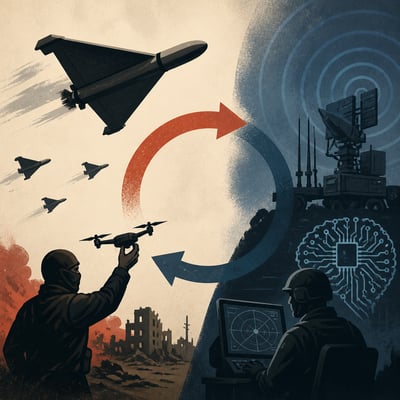
Cheap drones have become central to contemporary asymmetric warfare, especially in Ukraine and the Middle East, where weaker or resource-constrained actors can impose outsized costs on stronger militaries. The material shows a feedback loop of drone adaptation, electronic warfare, and rapid countermeasure development, including Russia-Iran Shahed exchanges and Ukraine’s large-scale interceptor drone response. It also highlights the growing role of AI-assisted targeting, autonomy, and industrial scale in sustaining drone warfare.

 Climate
 Privacy
 Bob Dylan
 Drones
 Data Centers
 AI Governance
 2026 Maine Senate Race