
 Climate
 Privacy
 Bob Dylan
 Drones
 Data Centers
 AI Governance
 2026 Maine Senate Race
AeroVironment Expands Counter-Drone Systems
Coverage from Fast Company, Interesting Engineering, and others
Articles
22
Active Days
78
The Topic
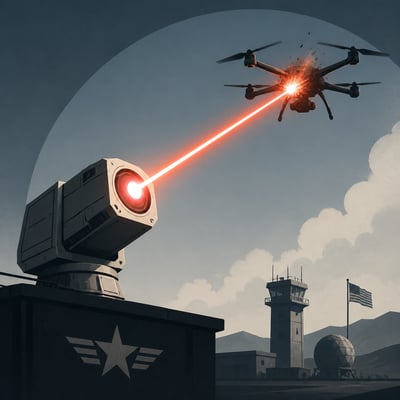
AeroVironment is expanding its counter-drone business as military demand grows for systems that can detect, jam, disable, or destroy small unmanned aircraft. The company’s Titan systems are moving into wider U.S. military deployment, while LOCUST directed-energy weapons and Freedom Eagle-1 kinetic interceptors broaden its defensive portfolio. The material also highlights a persistent operational challenge: many military drones remain highly vulnerable to laser attacks and lack publicly known systems to detect those attacks in progress.
First Article: 05/07/26
Latest Article: 07/23/26
Summary
- AeroVironment reported record fiscal 2026 sales and a $1.2 billion funded backlog, with counter-UAS revenue reaching about $200 million.
- The U.S. military awarded AeroVironment an $80.5 million Titan-MS counter-drone contract for Air Force installations.
- Titan-MS combines radar, sensor fusion, artificial intelligence, and countermeasures to track large numbers of small or autonomous drones.
- AeroVironment is positioning Titan radio-frequency jamming, LOCUST directed energy, and Freedom Eagle-1 kinetic interceptors as complementary defenses.
- LOCUST has been reported to have intercepted drones during a maritime demonstration aboard the USS George H.W. Bush.
- A Naval Postgraduate School study found that three of four representative naval drones could be destroyed within seconds by a 100-kilowatt laser without countermeasures.
- Drone survivability depends heavily on range, altitude, speed, airframe materials, and mission profile, while laser-attack detection remains a stated gap.
History
The story is slightly narrower and more operationally framed: AeroVironment’s counter-drone push is now described as moving into wider U.S. deployment, with a clearer emphasis on current military vulnerability to laser attacks. The biggest update is the added detail that drone survivability depends on specific mission and airframe factors, not just the existence of laser threats.
The story has shifted from Pentagon base-defense planning to AeroVironment’s commercial and military push into layered counter-drone systems, anchored by a major Air Force contract and strong financial results. It also broadens into a new vulnerability angle: how military drones themselves may be exposed to high-energy laser attacks.
Featured
Timeline: 78 Days
Hover over any logo to see coverage summary, click for full article.