
 Climate
 Privacy
 Bob Dylan
 Drones
 Data Centers
 AI Governance
 2026 Maine Senate Race
DJI Drones Lead Creator Buying Guides
Coverage from Popular Mechanics, The Drone Girl, and others
Articles
6
Active Days
83
The Topic
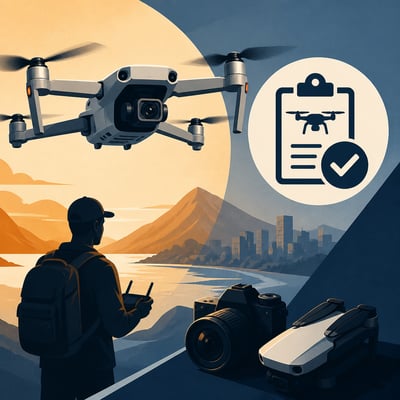
Consumer drone buying guidance is increasingly organized around specific creator and business needs, from compact travel and social-media filming to premium golf-course, cinematic, and low-light production. The DJI Mini 4 Pro is repeatedly positioned as a practical choice for most users, while the DJI Mavic 4 Pro serves higher-end photography and filmmaking; other models address beginner, action, portability, and budget needs. In the United States, commercial filming still requires FAA Part 107 certification, while FCC restrictions on certain foreign-made drones are adding uncertainty to future model availability.
First Article: 05/04/26
Latest Article: 07/25/26
Summary
- DJI Mini 4 Pro is repeatedly recommended for general creator, travel, and small-business use because of its compact 249-gram design, 4K video, obstacle avoidance, and vertical shooting.
- DJI Mavic 4 Pro is positioned as the premium consumer flagship for cinematic work, golf-course marketing, and photographers prioritizing its Hasselblad camera and larger sensor.
- Drone recommendations are becoming more use-case specific, with DJI Neo for beginners, Antigravity A1 for 360-degree action footage, and Air 3 or Air 3S for lower-cost camera work.
- Business filming, sponsored content, monetized videos, and client work are described as commercial operations requiring an FAA Part 107 Remote Pilot Certificate in the United States.
- Extra batteries, charging hubs, and ND filters are treated as practical requirements for longer shoots and controlled video exposure.
- A 2025 FCC action restricting new covered foreign-made drone models has introduced uncertainty for U.S. consumer availability, although previously approved models remain available according to the cited guide.
History
The story has become more granular and operational: drone recommendations are now tied to narrower creator and business use cases, and the regulatory frame is sharper because the FCC restriction is now dated and described as affecting future U.S. availability. The DJI Mini 4 Pro remains the mainstream default, but the addition of niche models and specific commercial applications expands how the market is being segmented.
The main shift is a sharper buying-guide framing: the story adds a specific low-light alternative, DJI Air 3, and elevates accessory and use-case tradeoffs in the recommendation set. The regulatory backdrop remains the same, but FCC restrictions now appear more explicitly as a constraint on U.S. availability.
Featured
Timeline: 83 Days
Hover over any logo to see coverage summary, click for full article.