
 Climate
 Privacy
 Bob Dylan
 Drones
 Data Centers
 AI Governance
 2026 Maine Senate Race
DJI and Antigravity Launch 360 Drones
Coverage from Tom's Guide, Dronexl, and others
Articles
10
Active Days
72
The Topic
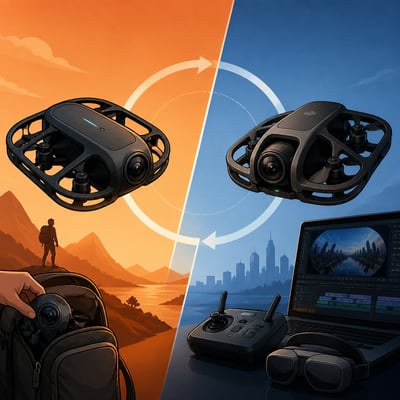
Consumer 360-camera drones are moving from specialist attachments toward integrated products, with DJI Avata 360 and Antigravity A1 offering 8K spherical capture, immersive goggles, automated tracking, and post-flight reframing. The two systems target different priorities: DJI emphasizes transmission, controller flexibility, obstacle sensing, and editing control, while Antigravity emphasizes portability, simpler operation, and a sub-250-gram standard configuration. The category gives creators more freedom to choose camera angles after flying, but adds weight, regulatory trade-offs, specialized controls, and greater post-production demands.
First Article: 05/18/26
Latest Article: 07/28/26
Summary
- DJI Avata 360 and Antigravity A1 make integrated 360-degree aerial capture available to consumers.
- Both drones use spherical video to let creators select camera angles and output formats after the flight.
- DJI offers stronger transmission, more controller options, propeller protection, and broader editing tools, while the A1 is lighter and more travel-friendly.
- The A1 can remain below 250 grams with its standard battery, but its higher-capacity battery exceeds that threshold; DJI Avata 360 is well above it at roughly 455 grams.
- Immersive goggles and motion controls lower some barriers for casual users but do not appeal equally to traditional FPV pilots seeking manual or Acro flying.
- The main practical cost of 360 capture is added editing and processing, alongside recurring stitch-line, horizon, and low-light limitations.
History
The story has shifted from a broad comparison of consumer 360 drones to a more concrete market picture: both products are now framed as integrated 8K systems with clearer distinctions in weight, control philosophy, and regulatory implications. The current version also adds more specific operational constraints, especially DJI’s much higher weight and the A1’s sub-250-gram boundary with standard batteries.
The story is now framed more clearly as a creator-focused product comparison, with stronger emphasis on practical buying factors like bundle composition, controller availability, and U.S. registration thresholds. The competitive balance remains the same, but the current version adds more detail about how workflow and legal constraints shape adoption.
Featured
Timeline: 72 Days
Hover over any logo to see coverage summary, click for full article.