
 Climate
 Privacy
 Bob Dylan
 Drones
 Data Centers
 AI Governance
 2026 Maine Senate Race
Counter-Drone Defenses Face Readiness Gaps
Coverage from Reuters, War on the Rocks, and others
00/00/0000
Articles
31
Active Days
81
The Topic
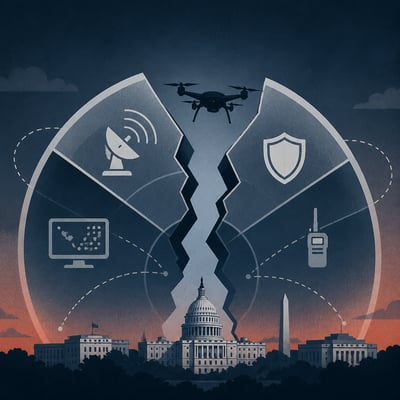
Governments, militaries, airports, and infrastructure operators are expanding counter-drone defenses after incursions and attacks expose weaknesses in conventional air-defense systems. The emerging approach favors layered architectures that combine radar, radio-frequency sensing, electronic warfare, visual and acoustic detection, guns, interceptor drones, and high-end missiles rather than relying on a single system. Adoption remains constrained by the cost and replenishment limits of missile interceptors, incomplete coverage, safety risks around civilian airspace, and unresolved legal and coordination requirements.
First Article: 05/07/26
Latest Article: 07/26/26
History
The story now places stronger emphasis on the economic and logistical unsustainability of using high-end missile defenses against cheap drone swarms, making the layered-defenses argument more urgent. It also broadens the civilian-policy side with clearer references to fragmented authorities and new guidance and procurement activity in the US and Europe.
The story has broadened from a general discussion of unauthorized-drone detection gaps into a more concrete counter-drone deployment and procurement picture. It now emphasizes layered defeat systems, battlefield-driven lessons from Ukraine and the Middle East, and the legal and operational constraints on using these tools in civilian airspace.
- Layered defenses now include electronic warfare, guns, and interceptor drones beneath missiles.
- Ukraine and Middle East operations are shaping current counter-drone deployments.
- ICAO is pushing interoperability and incident sharing for civil aviation.
- Civilian sites face legal and safety limits on jamming and kinetic interception.
- Counter-drone firms and airport operators are now named as active deployers.
The story is reframed more explicitly around fragmented U.S. authority and the need for shared airspace intelligence, with new policy momentum around expanding counter-drone powers. It also broadens beyond airports to protected airspace including borders and military sites, while keeping the core problem unchanged.
The story now puts more weight on suspected plots and commercial adoption, not just recurring drone sightings and policy discussion. It also broadens the operational picture by emphasizing layered sensing, shared airspace intelligence, and expanded local authority to respond.
The story has shifted from a general discussion of layered counter-UAS and fragmented authority to a more explicit policy and operational push for faster deployment, especially by non-federal responders. It also broadens slightly into public events and specific U.S. regions, while emphasizing readiness gaps in training, interoperability, and response authority.
The story has broadened from U.S. counter-drone coordination to a more explicit layered airspace-security framework that adds attribution, interdiction authority, and cross-jurisdiction response. It also now places stronger emphasis on operational strain from cheap drones and on lessons from Europe and Ukraine.
The story now centers more explicitly on an integrated U.S. counter-drone architecture, adding clearer emphasis on command-and-control, legal authority, and interagency coordination rather than just better detection. It also introduces DHS and JIATF 401 as more central actors in a homeland defense framework that still has unresolved coverage and interdiction gaps.
The story broadens from general counter-UAS integration to a more explicit focus on separating authorized from unauthorized drone activity in sensitive airspace, especially around airports, bases, and the border. It also adds AUVSI as a new industry actor and frames the policy problem more clearly around interoperable standards and legal authority.
The story has shifted from a general call for better drone detection and authority to a more concrete emphasis on integrated counter-drone airspace security. The new framing highlights implementation gaps around shared command systems, Remote ID, telemetry sharing, and coordinated interdiction across civil and defense stakeholders.
The story has shifted from a general push for coordinated counter-drone sensing to a more operationally urgent focus on rising incidents around airports, military sites, and borders. It also more clearly centers JIATF 401, FAA coordination, and integrated command-and-control as the practical path forward.
The story has shifted from broad counter-drone coordination to a more explicit framework for integrating authorized drone operations into the same airspace management picture. The updated version also adds clearer emphasis on small-drone air defense limits and on specific actors shaping the discussion.
The story has sharpened from general counter-drone detection concerns into a more integrated airspace-management problem, where the key challenge is tying drone sightings to operator identity, authorization, and threat level. It also more clearly frames Remote ID, FAA coordination, and NDAA authorities as partial components of a broader system rather than standalone fixes.
The story has shifted from a general U.S. counter-drone security problem to a more operationally defined effort that now includes integrating authorized drones into managed airspace. It also broadens geographically and institutionally, with clearer emphasis on Europe and vendor-led implementation of layered detection and command systems.
- Authorized drone operations are now linked to unmanned traffic management.
- Flight-intent sharing is being framed as part of airspace security.
- Europe now appears alongside U.S. security and procurement discussions.
- Vendor implementation activity is highlighted through DroneShield and Robin Radar.
- AUVSI XPONENTIAL 2026 officials are newly included in the narrative.
Drone activity is being framed as a growing homeland security and airspace management problem that current U.S. systems do not handle well. Across the material, the recurring issue is fragmentation: agencies can detect, regulate, or intercept parts of the problem, but no single system combines visibility, authority, and coordination. The strongest consensus is that effective defense will require layered sensors, shared data, clearer legal authorities, and integrated command-and-control rather than hardware alone.