
 Climate
 Privacy
 Bob Dylan
 Drones
 Data Centers
 AI Governance
 2026 Maine Senate Race
World Cup Counter-Drone Security
Coverage from The Jerusalem Post, Yahoo, and others
Articles
25
Active Days
82
The Topic
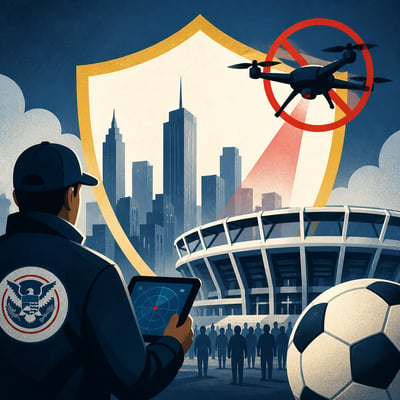
U.S. federal, state, and local authorities are deploying counter-drone systems, training officers, and enforcing temporary flight restrictions across World Cup venues in the United States, Mexico, and Canada. More than 1,000 drone detections and hundreds of mitigations or seizures have been reported at tournament-related sites, while FEMA funding and DHS technical support are expanding local capabilities. The effort is also exposing coordination, training-capacity, interoperability, and technology gaps, particularly against inexpensive cellular-controlled or improvised drones.
First Article: 05/07/26
Latest Article: 07/27/26
Summary
- Authorities reported 1,139 drone detections and more than 300 mitigations at World Cup and related sites by late June 2026.
- Federal agencies and local police are enforcing match-day restrictions covering airspace within three nautical miles of stadiums and up to 3,000 feet.
- FEMA awarded $250 million to 11 host states and the National Capital Region for counter-drone equipment, software, and training, with additional funding planned.
- The FBI National Counter-UAS Training Center in Huntsville is facing more demand than it can accommodate.
- Counter-drone operations are distributed across the FBI, DHS components, the Coast Guard, and local agencies using different systems and procedures.
- Current defenses commonly rely on radar, radio-frequency detection, jamming, or link takeover, but officials identify cellular-controlled and improvised drones as harder targets.
- A purported Handala breach of FBI drone footage was challenged by SITE Intelligence Group, which identified at least one video as recycled police-disaster-response material.
History
The story is mostly unchanged, but it is now more specific about the scale of drone activity and the defensive technology mix. It also adds a new commercial vendor presence at venues, suggesting a broader real-world deployment footprint.
The story has expanded from general World Cup drone enforcement into a larger, more operationally detailed counter-UAS campaign with concrete incident counts, major FEMA funding, and explicit training and interoperability limits. It now also extends beyond U.S. venues to the broader North American tournament footprint and a more developed discussion of technical constraints.
Featured
Timeline: 82 Days
Hover over any logo to see coverage summary, click for full article.