
 Climate
 Privacy
 Bob Dylan
 Drones
 Data Centers
 AI Governance
 2026 Maine Senate Race
Marine Corps Expands Autonomous UAS Programs
Coverage from GovCIO Media & Research, DRONELIFE, and others
Articles
4
Active Days
34
The Topic
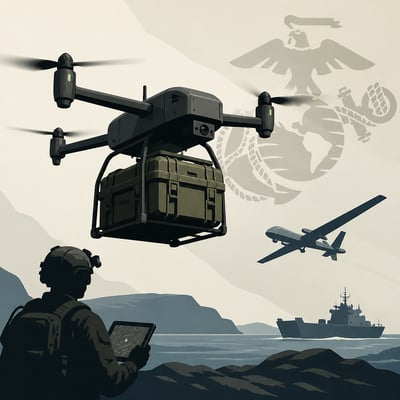
The U.S. Marine Corps is expanding autonomous UAS programs to support dispersed forces operating from ships and austere sites, with applications ranging from cargo resupply and persistent ISR to electronic warfare and strike. Key efforts include the MARV-EL logistics aircraft, the MUX TACAIR collaborative combat aircraft, and a modular command-and-control architecture intended to connect multiple UAS types. The programs could reduce exposure of crews and extend reach in contested areas, but weight, operator workload, maintenance, autonomy maturity, and testing timelines remain important barriers to fielding.
First Article: 04/30/26
Latest Article: 06/02/26
Summary
- MARV-EL is being prototyped as an autonomous logistics aircraft targeting a 1,300-pound payload and 100-nautical-mile combat radius.
- The MUX TACAIR program is preparing uncrewed aircraft to operate with manned platforms for strike and intelligence missions, with operational testing targeted for 2029.
- Marine Corps planners are pursuing modular command and control that can shift between autonomous and human control across different UAS platforms.
- Distributed operations are increasing demand for cargo aircraft that can resupply remote sites without exposing crewed aircraft to the highest-risk missions.
- Small-unit drones are extending sensing and engagement range, but batteries, controllers, ordnance, maintenance, and data analysis add weight and cognitive burden.
- Autonomy is being treated as a way to reduce the number of Marines required to operate ISR and attack drones, though the service expects flight autonomy to mature before full mission autonomy.
- The Corps is pursuing more organic control of ISR capabilities rather than relying primarily on contractor-owned and contractor-operated systems.
History
The story is now framed as a broader Marine Corps expeditionary autonomy push, not just logistics and strike, with added emphasis on electronic warfare and more organic ISR control. The update also sharpens the implementation picture by identifying MARV-EL as a prototype and highlighting the Corps' move away from contractor-operated ISR.
The story has shifted from a broad description of Marine Corps autonomy efforts to a more specific program-level picture, with clearer timelines, named platforms, and operational constraints. The biggest new development is that MARV-EL and MUX TACAIR are now tied to concrete payload, radius, and testing milestones, while the main barriers are framed more explicitly as integration and manpower problems.
Featured
Timeline: 34 Days
Hover over any logo to see coverage summary, click for full article.