
 Climate
 Privacy
 Bob Dylan
 Drones
 Data Centers
 AI Governance
 2026 Maine Senate Race
Marine Corps Expands Autonomous UAS Programs
Coverage from GovCIO Media & Research, DRONELIFE, and others
00/00/0000
Articles
4
Active Days
34
The Topic
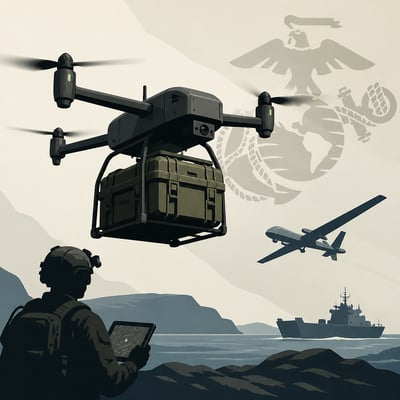
The U.S. Marine Corps is expanding autonomous UAS programs to support dispersed forces operating from ships and austere sites, with applications ranging from cargo resupply and persistent ISR to electronic warfare and strike. Key efforts include the MARV-EL logistics aircraft, the MUX TACAIR collaborative combat aircraft, and a modular command-and-control architecture intended to connect multiple UAS types. The programs could reduce exposure of crews and extend reach in contested areas, but weight, operator workload, maintenance, autonomy maturity, and testing timelines remain important barriers to fielding.
First Article: 04/30/26
Latest Article: 06/02/26
History
The story is now framed as a broader Marine Corps expeditionary autonomy push, not just logistics and strike, with added emphasis on electronic warfare and more organic ISR control. The update also sharpens the implementation picture by identifying MARV-EL as a prototype and highlighting the Corps' move away from contractor-operated ISR.
The story has shifted from a broad description of Marine Corps autonomy efforts to a more specific program-level picture, with clearer timelines, named platforms, and operational constraints. The biggest new development is that MARV-EL and MUX TACAIR are now tied to concrete payload, radius, and testing milestones, while the main barriers are framed more explicitly as integration and manpower problems.
- MUX TACAIR operational testing is targeted for 2029.
- Aerial Logistics Connector demonstration is planned for the Pacific in 2027.
- MARV-EL is specified to move 1,300 pounds over a 100-nautical-mile radius.
- Common Aviation Command and Control enables handoffs between autonomous and human operators.
- The story now names Kratos as the selected platform for MUX developmental testing.
The story has broadened from a general push toward autonomous Marine Corps drones into a more concrete program picture with named systems, contractors, and training/fielding activity. The biggest new wrinkle is that autonomy is now framed not just as a capability enabler, but as a way to cut workload and sustainment burden for small units at the tactical edge.
- MARV-EL targets 1,300-pound autonomous resupply payloads.
- MARV-EL is designed to deploy by C-130 to forward areas.
- Autonomy is now tied to reducing staffing, maintenance, and cognitive burden.
- Current scope includes electronic warfare and command-and-control support.
- The story now includes Bell Textron and Moog Inc. as new actors.
The story has broadened from a general Marine Corps autonomous drone push into a more specific aviation portfolio, adding organic ISR with Group 3 UAS and clearer emphasis on autonomous and optionally piloted systems across logistics, reconnaissance, and strike. It also reframes the effort as more execution-oriented, with testing timelines and command-and-control standardization now central.
The story moved from broad program momentum to more concrete execution, with specific contract, testing, and integration milestones now visible. It also sharpens the operational framing toward contested environments and collaborative combat roles, not just logistics and ISR.
- MARV-EL prototype autonomous resupply aircraft is under contract.
- MUX TACAIR operational testing is targeted for 2029.
- Common Aviation Command and Control System is being used to standardize UAS management.
- Drone roles now explicitly include future strike support.
- Persistent limits include payload, range, GPS-denied navigation, and autonomy safety.
The story has shifted from a general Marine Corps drone modernization effort to a clearer emphasis on autonomous logistics and tactical uncrewed aircraft under Marine operational control. The main new angle is that procurement and prototype work now appear to be progressing, but fielded capability is still limited.
The story shifts from a broad Marine Corps drone modernization effort to a more concrete program picture centered on procurement, standardization, and test planning. The updated version also makes Bell Textron a new participant in the overall effort.
The story has shifted from a general move toward Marine Corps drone procurement and testing to a more concrete program structure, with specific prototype, demonstration, and control-architecture efforts now named. The current version also frames the effort more explicitly as standardized, distributed expeditionary aviation rather than a set of separate drone initiatives.
The main change is a clearer emphasis on Marine-controlled organic ISR and modular command-and-control as part of the drone portfolio, alongside the same push toward logistics and tactical uncrewed aircraft. The story also becomes more concrete on timing and execution, with programs moving from concept toward procurement, prototype, and testing milestones.
The story has shifted from general Marine Corps drone development to a more concrete near-term execution picture, with stronger emphasis on operational testing, procurement, and field integration. The biggest new signal is that autonomous logistics and tactical UAS are now tied to specific programs and timelines, rather than just broad capability goals.
The story shifts from general program movement toward a more concrete execution phase: Marine drone efforts are now described as moving into contract awards, prototype activity, and planned testing. The framing also broadens slightly to emphasize tactical aviation alongside logistics, while keeping autonomous resupply and common C2 as the main near-term priorities.
The story has shifted from a broad developmental drone portfolio to a more concrete operational and procurement trajectory, with Marine Corps messaging now emphasizing Marine-controlled autonomous systems and standardized control architecture. It also sharpens the timeline and use case: autonomous resupply, reconnaissance, and strike support from expeditionary sites are now the central frame.
The Marine Corps is advancing a connected set of drone programs for logistics, ISR, and future tactical aviation, with current activity focused on procurement, developmental testing, and command-and-control standardization. MARV-EL, MUX TACAIR, and related autonomy efforts point to a broader shift toward distributed operations from austere sites and ships. The strongest signal is practical rather than conceptual: contracts, test timelines, and platform integration are now driving the program set.