
 Climate
 Privacy
 Bob Dylan
 Drones
 Data Centers
 AI Governance
 2026 Maine Senate Race
Marines Build Counter-Drone Training Hub
Coverage from Business Insider, Times of San Diego, and others
00/00/0000
Articles
11
Active Days
83
The Topic
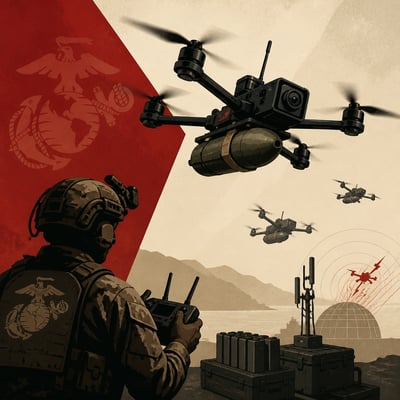
The US Marine Corps is building a broader system for using and defeating small battlefield drones, including new training organizations, counter-drone teams, expanded procurement, and experiments with helicopter-launched FPV aircraft. Marines are also addressing practical barriers such as operator proficiency, battery safety, electromagnetic-spectrum access, and interoperability across multiple drone types. The effort reflects a shift from isolated experimentation toward standardized capabilities intended for reconnaissance, attack, maritime operations, and defense against hostile drones.
First Article: 04/29/26
Latest Article: 07/20/26
History
The story now emphasizes a broader institutional shift: the Marine Corps is moving from experimental drone use toward standardized, force-wide fielding and training. It also adds a clearer focus on practical enablers and constraints, especially spectrum access, operator qualification, and interoperability across multiple drone systems.
The story has shifted from broad drone expansion to a more concrete force-wide training and counter-drone push, with new organizational structures and specific testing results. The biggest new development is that the Corps is now preparing to field far more drones while confronting contested-electromagnetic and anti-drone problems in parallel.
- Dedicated offensive-drone and counter-drone training organizations are being created.
- Exercises revealed difficulty defeating drones under jamming and electronic-warfare conditions.
- The Corps expects about 40,000 additional small drones.
- UH-1Y Venom and AH-1Z Viper helicopters successfully launched and controlled FPV drones.
- Fiber-optic drones are being explored for contested electromagnetic environments.
The biggest change is that the Marine Corps has moved from describing rapid FPV drone adoption to quantifying a much larger fielding push and showing it is now being operationalized through formal training, certifications, and exercises. The story also broadens from general scaling issues to specific sustainment and regulatory bottlenecks, plus live validation events such as Balikatan.
- Inventory is now reported at more than 3,500 FPV drones.
- New training tracks include operators, instructors, and payload specialists.
- Balikatan exercises are being used to validate attack-drone tactics.
- Battery storage, charging, and maintenance burdens are now emphasized.
- Airspace, spectrum, and cross-vendor compatibility are named constraints.
The story has sharpened from broad scaling and experimentation into a more concrete fielding effort, with leadership now describing thousands of FPV drones in service and emphasizing the systems needed to sustain them. It also adds named senior officers and a clearer focus on helicopter-enabled launch concepts and counter-jamming readiness.
- Leadership says thousands of FPV drones are now in service.
- Maj. Gen. Anthony M. Henderson, Brig. Gen. Simon M. Doran, and Col. Scott Cuomo are now named.
- Battery handling concerns now include lithium-fire risks.
- Helicopter-supported launch and command concepts are being tested more explicitly.
The story has broadened from scaling and training FPV attack drones into active experimentation with how Marines will launch and control them, including helicopter-based concepts. The added details also sharpen the operational constraints around interoperability, battery handling, and spectrum/airspace compliance.
- Helicopters are being tested as airborne command and launch platforms.
- Marine units are moving toward a large, service-wide FPV inventory.
- Interoperability and control-integration issues are more clearly identified.
- Battery storage and charging are emerging as key operational constraints.
The story shifts from general scaling of Marine small drones to a more concrete picture of routine FPV force development, with battery logistics and mixed-fleet integration emerging as the clearest operational hurdles. Counter-drone training also looks more embedded in preparation for contested environments rather than a side effort.
The story is less about broad expansion and more about the Marine Corps turning small-drone use into a formalized, operational capability. The newest emphasis is on institutionalizing training and exposing concrete integration constraints like safety, spectrum, and interoperability.
The story is slightly more concrete: Marine small-drone fielding is now described as a broader force-wide effort with specific training pathways and a named attack-drone platform, not just general rapid scaling. The added emphasis is on execution details around certification, unit-level training, and operational constraints.
The story has shifted from general rapid FPV-drone adoption to a more concrete picture of mass fielding, with thousands of drones now in play and training formalized around specific roles. The emphasis also sharpened on operational constraints, especially electronic warfare resilience and the support burden needed to sustain large-scale use.
- Thousands of FPV attack drones are being fielded.
- Dedicated instructor and payload-specialist courses are being added.
- Jamming and electronic warfare are identified as major obstacles.
- Lithium battery monitoring and fire-risk management are now explicit concerns.
- The Corps is signaling a doctrine for cheap, attritable small drones.
The story now emphasizes that Marine Corps drone adoption has moved beyond fielding into formal operator courses and integrated counter-drone training. It also sharpens the main constraints around airspace and spectrum limits, while adding Camp Lejeune and a named drone platform to the picture.
The story has sharpened from a broad push to field FPV attack drones into a more concrete picture of institutionalization: training, safety, interoperability, and counter-drone measures are now framed as the core enablers of large-scale use. The main new emphasis is on execution constraints and the service’s move toward routine, doctrine-backed integration rather than experimentation.
The cluster is centered on a rapid Marine Corps push to field FPV attack drones while simultaneously building counter-drone training, doctrine, and support systems. The current signal emphasizes scale-up, training pipelines, and operational integration, alongside practical constraints such as battery handling, spectrum compliance, airspace approval, and interoperability. The narrative is coherent and current, with only limited historical context from Ukraine-informed modernization framing.