
 Climate
 Privacy
 Bob Dylan
 Drones
 Data Centers
 AI Governance
 2026 Maine Senate Race
Britain Builds a Hybrid Drone Force
Coverage from BBC News, The Conversation, and others
Articles
23
Active Days
86
The Topic
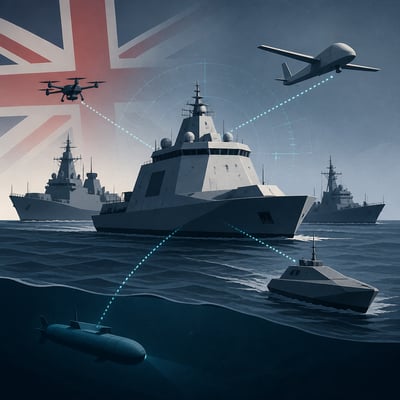
Britain is accelerating military drone development across all three services, combining autonomous aircraft, uncrewed maritime and underwater platforms, FPV strike systems, and drones designed to operate alongside crewed aircraft and warships. The effort includes a £5 billion funding commitment, an Uncrewed Systems Task Force, and Royal Navy plans for a hybrid fleet intended to add mass, persistence, sensing, and strike capacity. The plan could improve surveillance, logistics, and force protection, but questions remain over funding, procurement speed, electronic-warfare resilience, platform limitations, and the accountability of systems able to make engagement decisions with limited human input.
First Article: 05/03/26
Latest Article: 07/27/26
Summary
- The UK has committed £5 billion to drones and autonomous military systems across the Army, Royal Navy, and RAF.
- A new Uncrewed Systems Task Force is intended to move drone capabilities from testing to frontline use faster and at lower cost.
- The Royal Navy is testing remotely piloted helicopters, heavy-lift drones, uncrewed boats, and a proposed hybrid fleet of crewed and uncrewed platforms.
- Army plans include autonomous armed drones operating with Apache helicopters, surveillance replacements for Watchkeeper, and expanded FPV strike and interceptor drones.
- RAF programmes include autonomous drone wingmen for Typhoon fighters and Storm Shroud electronic-warfare drones.
- The expansion is informed by Ukraine's large-scale drone use, but UK stockpiles, industrial capacity, funding, and procurement timelines may limit near-term impact.
- Autonomous targeting raises questions about human authorization, rules of engagement, legal compliance, and accountability.
History
The story now places more emphasis on how the UK is actually organizing and fielding drone capabilities across the services, especially with the Royal Navy's hybrid fleet plans and the Army/RAF's specific platform programs. It also adds sharper constraints around human authorization, jamming resilience, and procurement capacity, making the effort look more operationally detailed but still bounded by implementation limits.
The story has broadened from a primarily naval hybrid-fleet debate into a cross-service UK defense procurement push centered on drones, autonomy, and faster fielding. What was once a planning concept is now presented as active funding, task-force coordination, and live trials across the Army, Navy, and Air Force.
Featured
Timeline: 86 Days
Hover over any logo to see coverage summary, click for full article.