History
07/25/20260 new articles
The story now places more emphasis on how the UK is actually organizing and fielding drone capabilities across the services, especially with the Royal Navy's hybrid fleet plans and the Army/RAF's specific platform programs. It also adds sharper constraints around human authorization, jamming resilience, and procurement capacity, making the effort look more operationally detailed but still bounded by implementation limits.
07/24/202618 new articles
The story has broadened from a primarily naval hybrid-fleet debate into a cross-service UK defense procurement push centered on drones, autonomy, and faster fielding. What was once a planning concept is now presented as active funding, task-force coordination, and live trials across the Army, Navy, and Air Force.
- More than £5 billion committed to drone and autonomous programs.
- Uncrewed Systems Task Force created to speed rollout.
- Carrier, shipborne, and airdropped drone trials are now underway.
- Army and RAF are now central to the drone transition.
- Critics highlight survivability, integration, and communications resilience limits.
06/29/20260 new articles
No material change is evident between the previous and current versions. The core narrative, planned capabilities, timeline, and cast of actors all remain the same.
06/29/2026Topic Formed
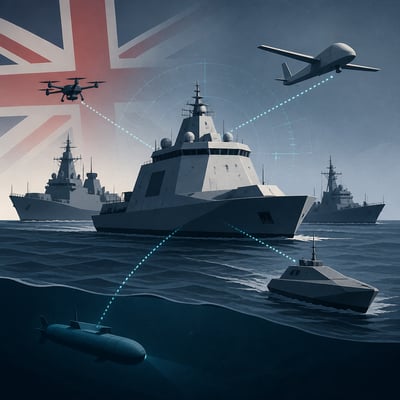
Britain is reshaping Royal Navy planning around a hybrid fleet that combines crewed warships with drones, autonomous vessels, and control ships. The center of the change is a new class of Common Combat Vessels that would coordinate uncrewed systems across air, surface, and subsurface domains, while older destroyer and frigate plans are being revised or deferred. The debate matters because it exposes a broader tradeoff between buying more autonomous capability and maintaining enough traditional warships to meet standing commitments.

 Climate
 Privacy
 Bob Dylan
 Drones
 Data Centers
 AI Governance
 2026 Maine Senate Race