
 Climate
 Privacy
 Bob Dylan
 Drones
 Data Centers
 AI Governance
 2026 Maine Senate Race
Schools Test Active-Shooter Response Drones
Coverage from The Guardian, Yahoo, and others
00/00/0000
Articles
25
Active Days
90
The Topic
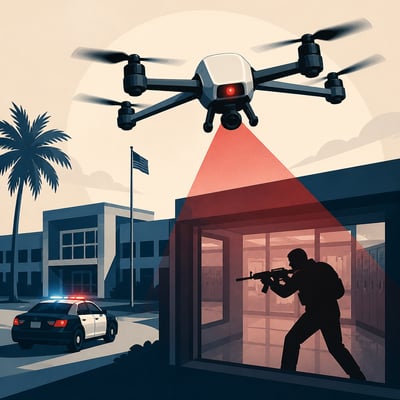
Campus Guardian Angel is testing remotely piloted indoor drones at schools in Georgia and Florida to respond to active-shooter threats before police arrive. The drones are designed to launch from on-site charging docks, use mapped buildings to reach a target quickly, provide live video and audio, and deploy measures such as sirens, strobes, pepper effects or kinetic impacts. State-funded pilots and demonstrations are expanding interest, but the system has not been used in a reported real active-shooter incident, leaving questions about performance, safety, cost and legal limits.
First Article: 04/30/26
Latest Article: 07/28/26
History
The story has shifted from general pilot activity to a more concrete deployment model, with Florida now linked to a named RADAR package that combines drones, firearm detection, and building maps. The update also slightly narrows the unresolved issues from broad legal and safety concerns to specific operational gaps like moving targets, bystanders, communications, and disabled drones.
The story has broadened from a couple of state-backed school drone pilots into a more developed multi-state implementation effort, with Arkansas now entering as an active demonstration market and Florida’s system more explicitly integrated with other safety tools. The framing also shifts toward deployment logistics and legal-accountability concerns rather than novelty.
- Arkansas demonstrations drew interest, but no state contract has been signed.
- Florida’s system now combines drones with cameras, AI alerts, and 3D maps.
- Drones are supported by school-based charging docks and remote pilots in Austin.
- The system is positioned as a supplement to, not replacement for, responders.
- EFF’s concern now centers on proportionality and accountability standards.
The story has expanded from a Florida school-drone pilot into a broader multi-state active-shooter response program, with Georgia now funding a formal Campus Guardian Angel rollout through 2027. The new version also adds concrete integrations and sharper safety/legal concerns, especially around using drones to apply force inside schools.
- Georgia allocated $550,000 for a Campus Guardian Angel pilot through 2027.
- Florida backed a $557,000 program across Volusia, Leon, and Broward districts.
- Godby High School is integrating ZeroEyes and Ark Strategic with the drones.
- Demonstrations have not yet proven the system in moving-target or real attack conditions.
- EFF says federal law lacks clear standards for drone-deployed force against people.
The story has broadened from a Florida/Georgia school-security pilot into a more concrete implementation update centered on Deltona High, with clearer details on fixed-dock deployment and remote operation from Texas. It also now extends beyond schools to a Dutch emergency-response pilot, widening the use case.
- Deltona High School is the lead Florida pilot site.
- Drones are expected to reach targets in about 15 seconds.
- Operators in Austin, Texas, remotely control the system.
- A Dutch incident-response drone pilot is underway in Veenendaal.
- Supporters frame drones as a way to buy time before law enforcement arrives.
The story has broadened from Florida-only pilots to a multi-state rollout, with Georgia now joining funded school drone deployments. The update also strengthens the sense that this is moving from testing toward implementation, while doubts about performance and safety remain unresolved.
- Georgia schools are now included in the pilot rollout.
- Georgia budget allocations are funding deployments.
- Florida Legislature grants are supporting initial installations.
- Systems can launch from indoor or hallway docking points.
- Critics now highlight misidentification and cybersecurity risks.
The story shifts from emphasizing state-funded pilot deployment to highlighting operational testing, with greater attention to whether the drone system can actually work in a real emergency. The current version also adds clearer detail on the deterrence tactics and reframes the main uncertainty around cost and effectiveness.
The story has shifted from a general Florida school drone pilot to a more concrete, state-funded installation test led by Campus Guardian Angel, with Deltona High School now the clearest deployment site. The current version also emphasizes that these are human-operated systems being installed for inside-school use, not just a conceptual emergency-response pilot.
The story is largely unchanged, but the framing has broadened slightly from a specific Florida district pilot to a more general school-security procurement model backed by the Florida Legislature. The current version also sharpens the operational picture by emphasizing fixed launch boxes and clearer response-use details.
The story is now framed less as a one-off school pilot and more as a small, multi-school emergency-response program in Florida. The new version also adds clearer uncertainty about whether the system’s speed and effectiveness depend on human remote operators or autonomous capability.
The story has sharpened from a general Florida school-drone pilot into a more vendor-specific, operational deployment centered on Campus Guardian Angel and school safety execution. The new version also emphasizes that the program is limited to selected pilot schools and tied to the school-year rollout, reinforcing this as an implementation story rather than a broader drone-market shift.
The story is mostly the same, but the current version sharpens the operational picture: the drones are now framed more explicitly as a live school-safety tool with app-triggered deployment and remote pilots in Austin. It also slightly shifts emphasis toward implementation details and away from the earlier focus on launch mechanics and broader rollout framing.
The story shifts from a general pilot description to a more concrete operational rollout, with clearer details on how the drones are deployed and who is running them. The main new takeaway is that the program is now framed as an early execution phase, not just a planned security concept.
The story shifts from a broad description of a school-drone emergency pilot to a more concrete state-funded deployment effort, with clearer evidence that the program is already being installed in Florida schools. It also newly situates the drones within a wider school-security stack that includes alerts and AI gun detection.
The cluster is centered on Florida school-campus emergency response drones, especially a Campus Guardian Angel pilot at Deltona High School. Coverage focuses on rapid-response deployments, remote piloting, livestreamed video to law enforcement, and non-lethal deterrence tools intended to shorten reaction time during a suspected active-shooter event.